
Big Bang Theory
A Creative Thinking Masterclass

If you thought the evolutionists’ canvas was Jackson Pollock-like, you ain’t seen nothing yet. The court cosmologists have been allowed to run riot and their deceptions are more difficult to detect, given the esoteric nature of their subject matter and the difficulty in understanding it. It’s one of those disciplines that is littered with strange symbols and equations. As such, it’s a prime candidate for subversion, as there are too few with the ability (and inclination) to keep the ‘experts’ honest. Subsequently, all manner of tweaks and ad-hoc addendums have been tacked on to the approved narrative when genuine scientists should, at the bare minimum, have considered the possibility that perhaps, just perhaps, their foundational assumptions were the problem instead. And central to those assumptions is the Big Bang Theory.
There is method in their madness: “The big bang was invented specifically for the purpose of doing away with the creation event,”(1) a belief in which was still the dominant paradigm at the onset of the twentieth century. However, the overarching desire to hold fast to their theory at the expense of objectivity and, increasingly, credibility, is not without risk, if exposed to sunlight:
“In no other field of physics would this continual recourse to new hypothetical objects be accepted as a way of bridging the gap between theory and observation. It would, at the least, raise serious questions about the validity of the underlying theory [emphasis in original].”(2)
Cosmology isn’t serious science – it’s the Wild West in a sandbox and only those sporting a research lab lanyard get to play. The rest of us are supposed to uncritically accept what the smart folks tell us. And, since 1931 and a Belgian cosmologist named Georges Lemaître (also a Catholic priest), it’s been the concept of the ‘primordial atom’, later named the Big Bang Theory (BBT). He’d originally published his paper in 1927, but it had remained untranslated until other cosmologists – including Einstein – decided that static models of the universe were no longer satisfactory.
The legend is that the latter, when calculating his General Theory of Relativity, had realised that the universe would tend to collapse under gravitation in his model and so, rather than starting over with another back of a envelope calculation, he introduced the first of many subsequent fudges, the Cosmological Constant, represented by the Greek symbol Λ—lambda. Although it’s value was very small, when shoehorned into his calculations, it succeeded in pushing the galaxies apart and maintaining the static universe. Then came 1929 and the Hubble telescope, which purportedly showed that distant galaxies – a recent discovery – were receding from the earth “at speeds proportional to their distances.”(3)
Lemaître’s main contribution to the study of cosmology was to follow through on his original hypothesis. He figured that, if the universe was expanding, it had been smaller in the past; not, you might think, an earth-shattering insight. However, when extrapolated back in time, Lemaître asserted that one must eventually reach an epoch when all matter was “packed together in an extremely dense state.”(4) In his telling, the physical universe was initially a single particle, which then exploded, creating space, time and an ever-expanding universe.
This struck a chord amongst his cosmological brethren, who adopted the concept with alacrity, regardless of the fact that it trampled all over accepted laws of nature:
“By having matter appear out of nowhere, it violates the law of conservation of mass and energy. By having that matter self-organize into hot stars, galaxies, and superclusters—all while it should have been thinning out and cooling during eons of expansion—it violates the law of entropy.”(5)
That would be the First and Second Laws of Thermodynamics, consigned to the circular file; not in other instances, mind – just for the Big Bang Theory. So, more temporarily suspended than permanently dismembered. For some, this demonstration of blind faith in what, essentially, is a miracle, is typical of the quality of critical thinking in Bubbleland - “the realm beyond the present reach of science.”(6) This is a place where all manner of magical is permissible, provided it is generally supportive of a ‘random chance’ explanation for existence. In reality, it’s where pigs and lipstick exist in ideal proportions:
“Big bang cosmology is probably as widely believed as has been any theory of the universe in the history of Western civilization. It rests, however, on many untested, and [in] many cases, untestable assumptions. Indeed, big bang cosmology has become a bandwagon of thought that reflects faith as much as objective truth.”(7)
It’s worth noting that the original premise – the one that catapulted Lemaître to prominence – has still not been confirmed. The narrative engineers, the type of people who routinely feature in grand deceptions, have consistently misconstrued Hubble’s findings. In their telling, his telescope definitively proved that the universe was expanding, due to ‘redshifting’ (which I’ll explore in more detail shortly). Hubble himself remained unconvinced for the remainder of his days:
“Redshifts have been interpreted as a velocity of recession, i.e. that galaxies are moving through space. And that the recession implies expansion of the universe. But Hubble, up to the time of his death, was not so convinced of this interpretation. He was open to the possibility that there could be another mechanism to explain redshifts.”(8)
The Big Bang Theory is unsustainable sans an expanding universe, yet the mechanism that undergirds this assertion is unproven, as we shall see. We could stop there; but I’m going to keep the camera rolling, whilst being mindful of a tendency to play into the hands of the enemy. There is a danger of wading too deeply into the weeds, whilst bypassing the big stuff. After all, it only takes one black swan to disprove the notion that all swans are white. Put another way, if we know that the Germans dressed up as Polish soldiers and staged the border provocation that started World War II, there’s little point in engaging in a huge debate as to the quality of their uniforms or accents.
So, WPC Yvonne Fletcher wasn’t killed by shooters from the Libyan Embassy in London in 1984, because the trajectory of the bullet renders that scenario impossible (see Part Four). 9/11 wasn’t the work of Islamist hijackers, because the laws of physics dictate that the Twin Towers were brought down via controlled demolition, a circumstance confirmed by the hundred plus witnesses who heard the explosions (see Empires Are Built On Myths). AIDS is not a thing, as thousands have recovered from it (not HIV, AIDS) by cleaning up their lifestyles (see Deja Vu All Over Again).
You get the picture – apologists for mendacious narratives would prefer to ensnare critics in a web of minutiae and skip by the most obvious and basic calumnies, and the same dynamic is at play with the Big Bang. Creationists, pretty much the only source of alternative information, fall into this trap on a regular basis when they should be consistently hammering the large absurdities, not the minor ones. If the big-ticket items are ersatz, it follows that everything downstream is also baloney. It doesn’t need to be dwelt upon. But there are plenty of humongous issues with BBT that do deserve attention. As noted:
“The currently leading evolutionary cosmogony (Gk. ‘birth of the universe’) is the big bang theory. This basically says: nothing exploded and became everything. One part of this is energy turning into matter, as per the famous Einstein formula E = mc².”(9)
According to the laws of particle physics, were this miracle to occur, an equal amount of matter and antimatter would be produced. Not kinda equal – precisely equal. But antimatter particles exist only fleetingly and, when they do, they interact with matter particles and are mutually annihilated. The same process is observed with antielectrons, antiprotons and antineutrons.(10) The question, then, is how did we arrive at a place where matter predominates, when it should not have survived annihilation by an equal amount of antimatter?
The Big Bangers, working from the end backwards in familiar fashion, allege that most matter was destroyed but, in the early universe, there existed a billion and one protons for every billion antiprotons. Over time, the imbalance became exacerbated.(11) Welcome to Bubbleland. But it must be so because a) the BBT is correct and b) observationally, matter dominates. Of course, in order for this minor imbalance to exist, there must be “asymmetry in the fundamental makeup of the universe.”(12) Unfortunately, despite strenuous efforts, the cultists have been unable to find any. The lead researcher at CERN in Switzerland was somewhat despondent:
“All of our observations find a complete symmetry between matter and antimatter, which is why the universe should not actually exist.”(13)
Which, technically, isn’t quite right, because he is still clinging to the wreckage of BBT. The universe clearly does exist – just not as the result of a Big Bang, according to his findings. Naturally, despite the passage of eight years since the failed experiments, the orthodoxy continues to be preached and, if it’s eventually ditched, it will be in lieu of another naturalistic theory. My impression is that the truth is of little import; it’s the narrative that must be maintained, which is eminently achievable if approved engineers are permitted to curate it.
‘Matter’, more generally, was already in the doghouse for other reasons. Or, to be precise, ‘dark matter’ – the “god of the gaps”,(14) a fudge factor extraordinaire. Any theory can be rescued if one is allowed to insert invisible stuff so that theory and observation can be reconciled. So, we get dark matter, which cannot be seen because it emits no light or radiation and, hey presto, all is well with the world, once again. It has unknown properties and strange behaviour; a kind of cosmological duck tape, there to keep the show on the road. No-one has even proven that it’s real, nor will they, because it isn’t. If it was, many observed galaxies wouldn’t exist,(15) and the Milky Way and Andromeda would have to be random spheres. Which they’re not.
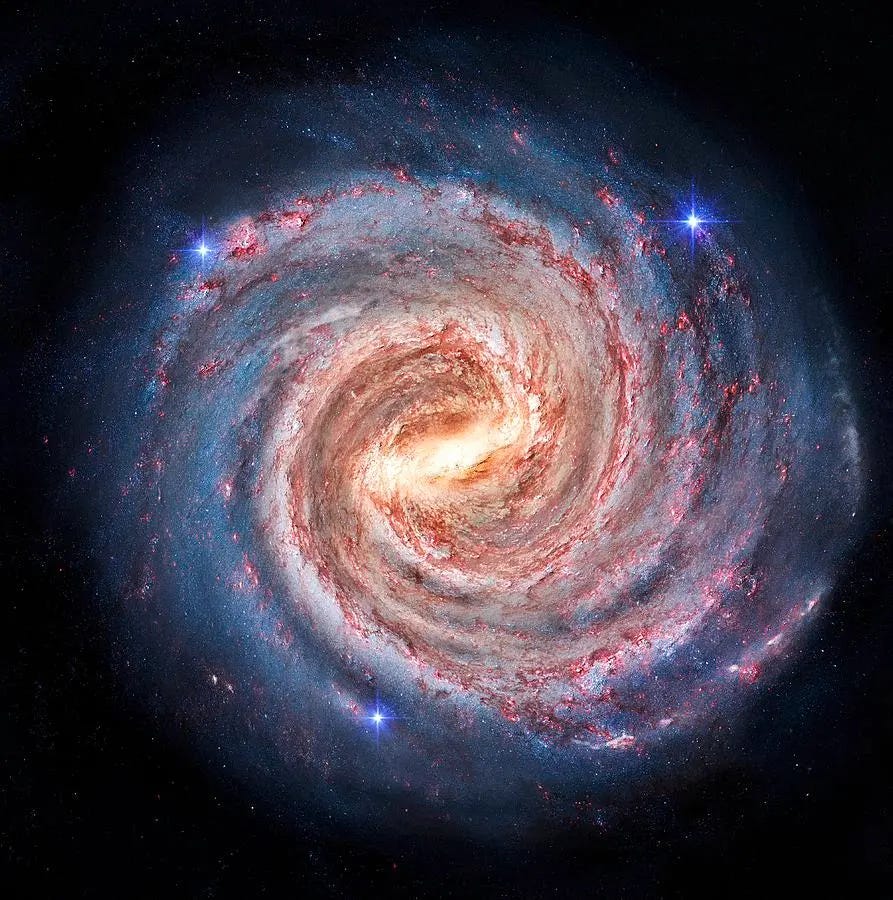
Figure 1
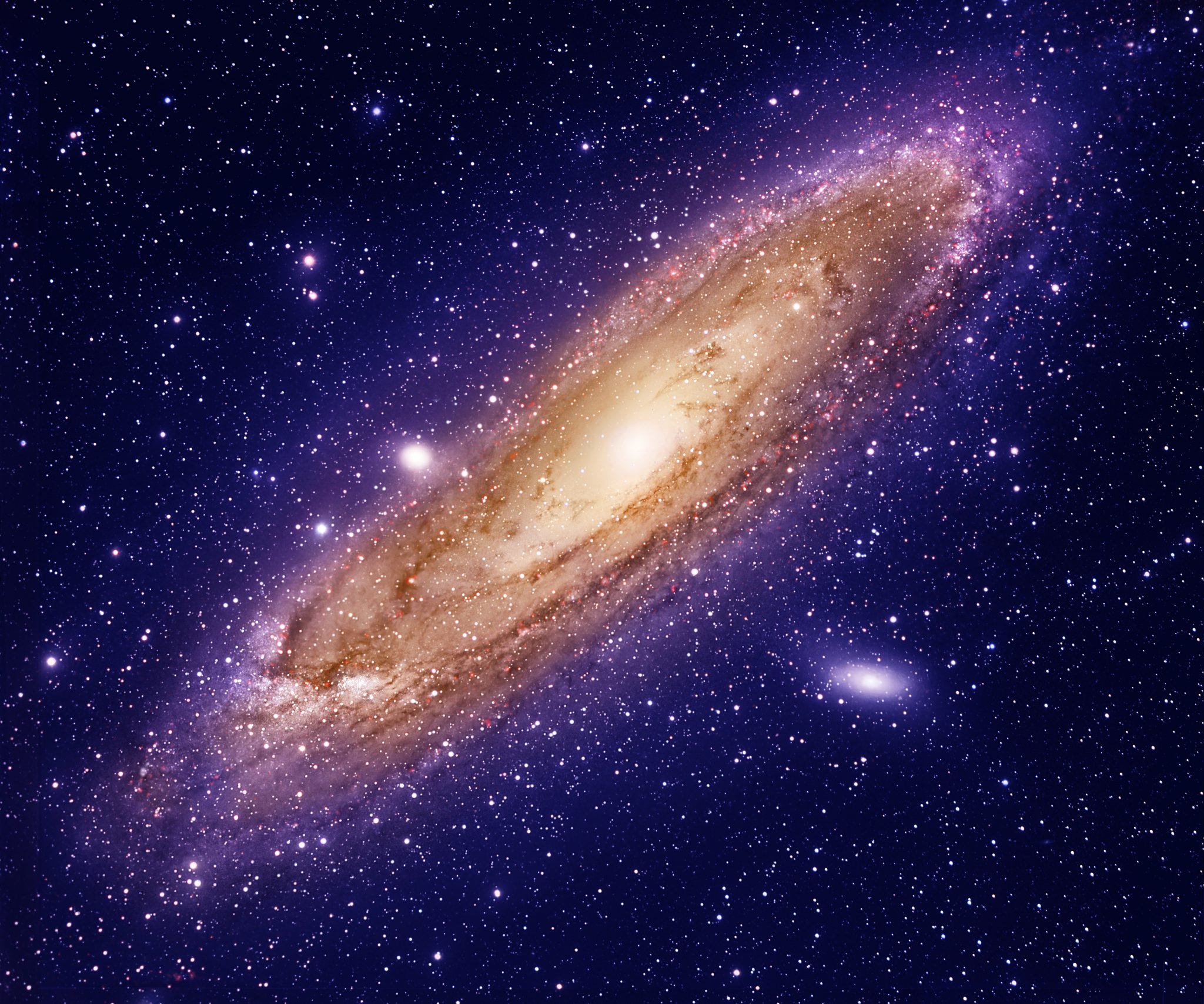
Figure 2
Nonetheless, the cosmologists still maintain that they’re on the right track, because warm and fuzzy feelings are endemic in the Land of Bubbles. For the BBT to work, there needs to be a lot of dark matter; although, to be fair, they are now prepared to acknowledge that other dark stuff also features:
“Big bang cosmologists propose that about 25% of the universe is made up of dark matter...70% of the universe in their models is made up of the even more obscure dark energy, leaving 5% of the universe as ordinary matter.”(16)
Without dark matter, a Big Bang would not lead to the formation of stars and galaxies, because the gases would not be able to condense. As we can see stars and galaxies are out there – and, if you recall, the BBT is correct – so dark matter must exist, because normal matter just wouldn’t have gotten the job done. If you can come up with a more pristine example of circular reasoning, I’d be glad to hear it. The explanation that better fits the evidence cannot be entertained:
“The solution is simple—dark matter never existed in the first place. That is why it is missing. It is invisible because it is not there. The standard big bang universe formation theory is wrong.”(17)
The legend around dark energy is no less problematic, in large part because they can’t find that, either. It’s needed because there must be some other anti-gravity force in the universe, if all the complicated Big Bang equations are to work. Also, because the high priests of cosmology have interpreted observations as showing that the universe is not only expanding, but doing so at an accelerating rate, dark energy is essential. As is their wont, they simply stick another Band-Aid on the model – this time, a ‘chameleon particle’ is the best candidate:
“Only in empty space does the hypothesized chameleon particle take on the characteristics which provide a new anti-gravity force in the universe, hence dark energy. But when you look for it near Earth it takes on a new identity and hides itself so you cannot find it.”(18)
So far, then, a not-insubstantial cavalcade of omissions and a theory that looks like it should have been given the last rites decades ago. Every moving part is either seized up or non-existent. Not only does the BBT violate natural laws, it is also internally inconsistent, as matter would not exist in a symmetrical universe – and the great god of uniformitarianism demands that what works now also worked in the dim and distant. Additionally, ‘dark’ anything is just another way of admitting that the our cosmological guides know not of what they speak. They are also hamstrung by their refusal to countenance the probability that Einstein’s general relativity theory might not be all it’s cracked up to be, as shortcomings in those calculations make leaps of faith a necessity:
“But when that was applied to the universe as a whole, two problems developed for the secular model. One is the need to add in dark energy... and the other is the need for a significant amount of invisible cold dark matter (CDM).”(19)
Yet more distortions and fudge factors are infinitely preferable to a review of what constitutes the foundations of secular theory with regards to the creation of life itself. Which brings us back around to redshifts. Because there was a Big Bang, there is still an expanding universe and redshifting proves it, right? Well, no – not really. There is another explanation that fits observations as well, if not better, and it’s known as the ‘tired light theory’. The BBT relies on the Doppler effect which, in space, explains the increase or decrease in the frequency of light waves depending on distance; if a body is moving away from us, it moves towards longer wavelengths, its light spreads out and appears to ‘redshift’. If a body is moving towards us, the wavelengths compact and it appears to ‘blueshift’. As all galaxies ‘redshift’, the universe must be expanding.(20) Or so the story goes.
Einstein’s second great theory – that of Special Relativity - “holds, as a basic assumption, that the speed of light will always be the same everywhere in the universe”,(21) (except when it isn’t, like just after the Big Bang), although the behaviour of light beyond our own universe cannot be known. Additionally, the law of entropy dictates that, over time, energy disperses and becomes less useful. For the Great One’s ‘untired light theory’ to be correct, we would once again be required to entertain certain deeply implausible accommodations. For one, perfectly empty space. Also, perpetual travel:
“Perfectly empty space has been found nowhere, with even the intergalactic regions long known to be filled with a veritable particle zoo. But perfectly empty space would be necessary for perpetual travel, which could not abide any loss of velocity or energy whatsoever.”(22)
Additionally, intergalactic distances have been measured for the past twenty years and no expansion has been detected.(23) Which is not to dismiss the Doppler effect in its entirety as nearby galaxies, such as some in the aforementioned Andromeda, are blueshifting which, as the observant will no doubt note, shouldn’t be happening either, if everything is going away from us.(24) However, when more sensitive instruments demonstrated that the largest redshift galaxies were allegedly moving away at a speed faster than that of light, Doppler had to be largely abandoned in favour of yet another revision to BBT, Guth’s inflationary universe – another ingenious construct built on sand. More on that in a moment.
The establishment interpretation of redshifting is under attack in other ways, too. Quasars, supposedly extremely distant, supermassive black holes are said to be early examples of the mature galaxies that surround us today. They’re extremely bright and are possessed of very large redshifts, as befits objects that are many billions of years old. So far, so good. The problems started when observers started to go all forensic. Quasars presumed to be six billion light years away were measured against those at ten million. Unfortunately, the light signatures were exactly the same.(25)
Obviously, that does not compute, as a distance of four million light years – between clusters of quasars – should have resulted in markedly different redshifts. Further, the brightness of the quasars varied significantly over very short timeframes, such as a week or even a day; from billions of light years away. All calculations, however, are predicated on the BBT, meaning that the redshifts must be cosmological in origin and the result of recession. But once again, actual observations undermine the master theory. It may very well be that quasars aren’t actually that far away and that redshifts aren’t always indicators of distance. Instead of a stretching universe, light simply loses energy over time. And the universe might have ‘stretched’ in the past, but isn’t doing so now.
Some of the galaxies at the highest redshifts are also dominated by blue stars,(26) and the redshifts – rather than being “evenly distributed across a range of velocities”(27) (as per the official version) – are actually evenly distributed in groups, at 100 kilometres an hour, 200 an hour, 300 an hour and so forth.(28) Nobody seems to know quite what to do with these data, although it tends to undermine the random chance/BBT argument somewhat, as any suggestion that there might be some kind of order to things ist verboten. However, it is hardly the only phenomenon that does that.
We are informed that the universe came into existence with an almost perfectly even distribution of matter, which only coalesced over many billions of years – from stars, to galaxies, to clusters and then to superclusters.(29) Once again, observations give the lie to theory, as “larger and larger structures have been uncovered at earlier and earlier times.”(30) According to the orthodoxy (and given the current low velocities of galaxies), these structures would have taken hundreds of billions of years to form, yet even the diehards don’t claim that the universe is older than 14 billion years.(31) Clearly, there is a maths problem. But there’s also a randomness problem. And a uniformity problem.
According to the latest patch, there was a faster-than-light period of expansion – although it only lasted “about 10^-32 of a second” -(32) before normal service was resumed:
“The universe begins with the normal rate, which is actually quite rapid, but is slow by comparison to the next phase. Then it briefly enters the inflation phase, where the universe expands much more rapidly. At a later time, the universe goes back to the normal rate...The inflation model allows points A and B to exchange energy (during the first normal expansion) and to then be pushed apart during the inflation phase to the enormous distances at which they are located today.”(33)
None of that ‘science’ can be proven, nor does it make any sense, but it is the only way that the BBT can be salvaged. In reality, we are paying another flying visit to Bubbleland:
“One event does not lead naturally to the next, so a multitude of incomprehensible causes have to be cobbled together to get the expansion going and to make it produce a universe.”(34)
Nonetheless, adoption of the inflation model allows the big-brained cosmogonists (whose job it is to ‘study’ the origins of the universe) to claim that they have solved the problem of the cosmic microwave background (CMB), which would otherwise be far too uniform for comfort. The CMB, in all directions, is 2.7 K (-455°F) and only varies by one part in 105.(35) In the trade, this is known as the horizon problem, because both sides of the observable universe haven’t had enough time to exchange energy and achieve equilibrium – not if the speed of light is top gear, at any rate. But, if that exchange took place in the fractions of a second after the Big Bang, all is well. Nothing to see here, move along. They haven’t got all day - it’s time to magick up a wholly plausible explanation for more anomalies.
Such as the conviction that the Big Bang would distribute matter evenly in a homogenous fashion. Thus, the distribution of the galaxies would be, to a large degree, uniform. But, by the early 1980s, it became apparent that this prediction was also wrong and that most of the deep universe is comprised of cosmic voids, hundreds of millions of light years across (allegedly) – 80% of the volume of the universe, yet only 10% of the mass.(36) And what remained wasn’t random – it was structured:
“Galaxies in our universe are not scattered about randomly like salt spilled on the table; instead, they form the largest pattern found in nature. We see dense clusters, home to thousands of galaxies, and long, thin strands connecting these clusters. These strands act like long highways stretching between the clusters, with thousands of galaxies strung along them. And we see those strands bound together to form broad, immense walls.”(37)
Not homogenous, then, but clumpy. Not random, but structured. How to solve the conundrum without abandoning the BBT? Simple, when you know how. Lean into the ‘more matter than anti-matter’ canard - “tiny, random, microscopic differences” that have never been replicated -(38) throw in a dash of gravity and those areas with a slight advantage in terms of mass also had a greater gravitational pull. Over billions of years, I give you galaxies and voids. It almost certainly looked something like this, although not in a box shape not yet, anyway. From unstructured fog to what we see today.
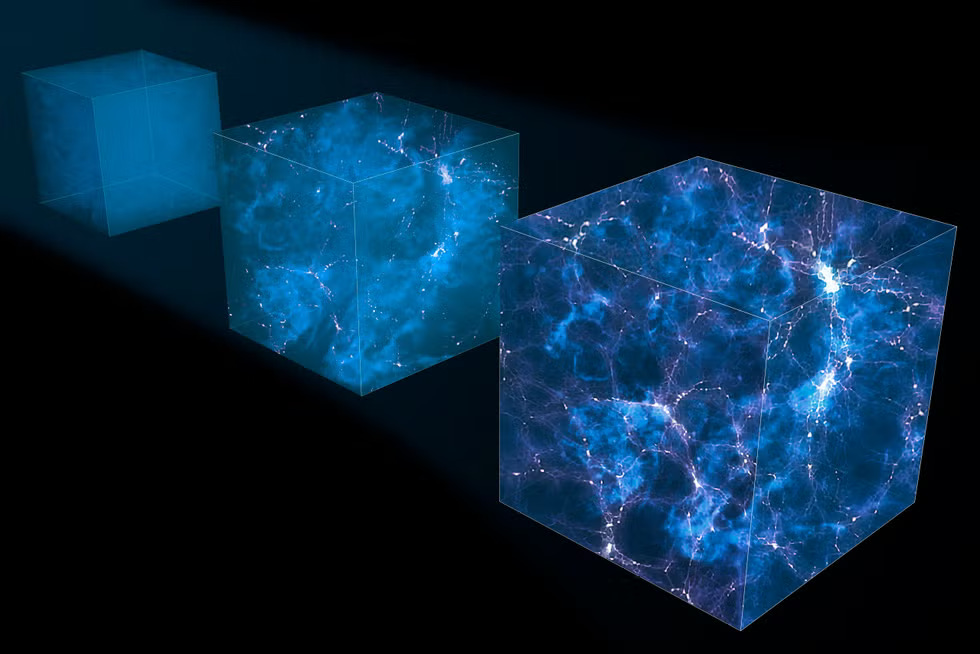
Figure 3
I wasn’t there, so I can’t tell you whether this latest update is accurate or not, but I can tell you that not a single part of the Big Bang Theory obeys the physical laws that are (supposedly) the same now as they were then. But each revision of the theory is presented as fact. The scientific journals evince no uncertainty – they speak of dark matter and dark energy as though they exist, because (to them) they must, because the theory is true. So, instead of critical thinking, we get more nonsense; string theory, eleven dimensions, Loop Quantum Gravity, modular space-time theory and more besides, each construct more implausible than the last.
“So the problem to date has been not what one would call prediction but retro- or post-diction. The result is known and the desired effect is put in by hand.”(39)
Given the fact that the BBT is fubar, it follows that any calculations based on its tenets are also likely to be highly unreliable. So it is with the supposed age of the universe and, by implication, Earth. Garbage in, garbage out. There must be a reliance on redshifting and on a uniform speed of light across galaxies. No tired light, no entropy, no truck with very distant, mature galaxies, no doubt as to the existence of dark whatever, no acknowledgement that a clumpy universe ought to produce inhomogeneity in the CMB and no doubt as to their methods. This is what results.
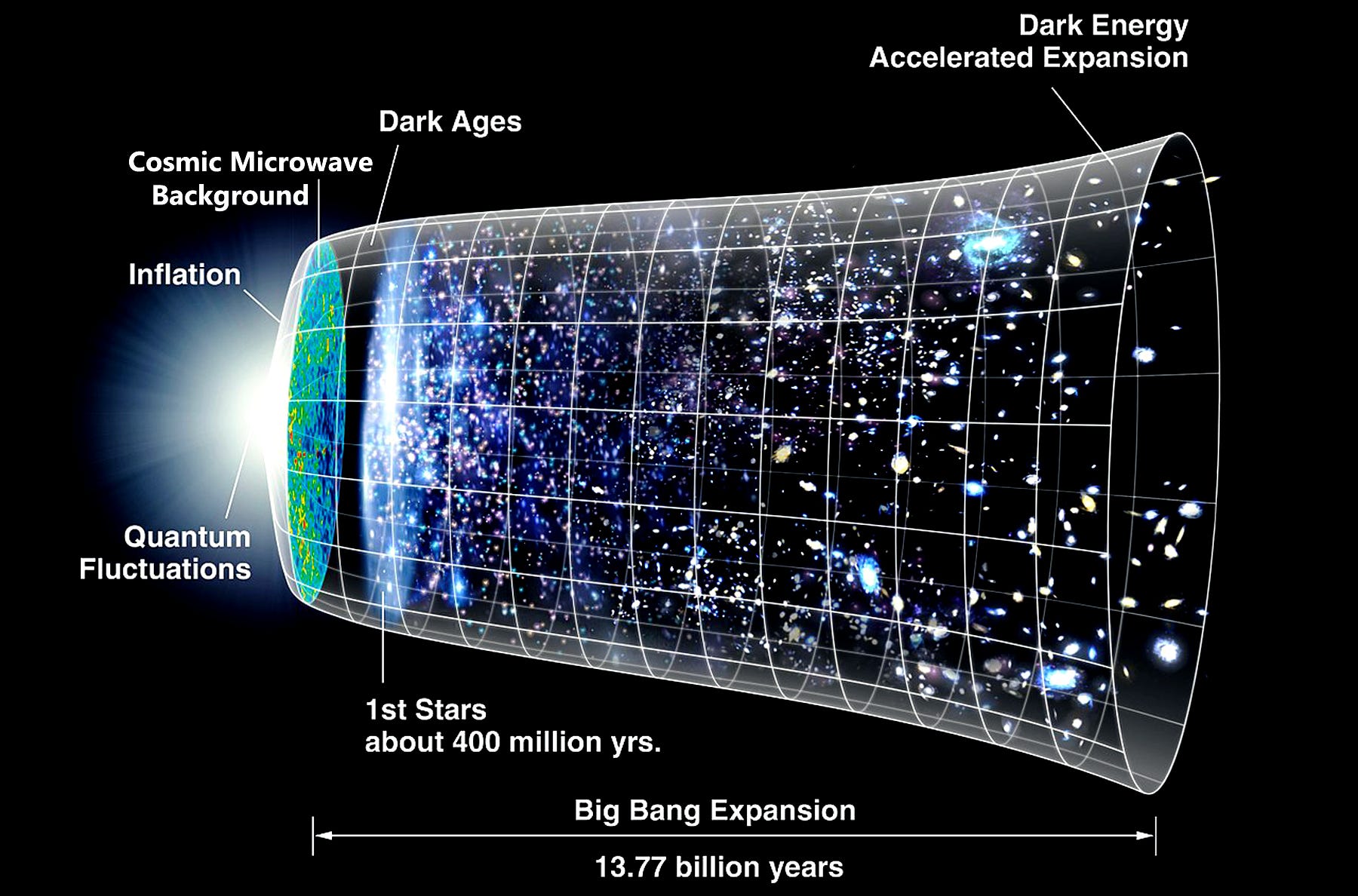
Figure 4
Considering the size of the number, it’s pretty precise, isn’t it? Authoritative, one might think. The age of our solar system (and Earth) is even given to three decimal places – 4.543 billion years.(40) So, to within three million years over a span of 4,543 million years. Impressive. What methods could they have used to arrive at such a number with certainty? Well, with as much certainty as the rest of the priesthood’s prognostications, anyway.
As previously noted, before the invention of dark energy, the age of the universe was calculated to be less than that of some of the objects within it. Understandably, some questioned whether the cosmogonists knew what they were talking about. Fortunately, with the addition of some tasty hypotheticals – with dark matter and a rehabilitated cosmological constant to the fore – and Hubble’s Law (the redshift explanation that he was never sold on), an assist from the Friedman equations and a sprinkling of fairy dust, we end up with the following, easily accessible equation.

Figure 5
It’s all pretty straightforward, apparently. Although, as Wikipedia generously allows, the age “is based on the assumption that the project’s underlying model is correct.”(41) There is much talk of ‘age clocks’ and oodles of misplaced confidence.
“However, no scientific method can prove the age of the earth and the universe...Although age indicators are called ‘clocks’ they aren’t, because all ages result from calculations that necessarily involve making assumptions about the past. The starting time of the ‘clock’ has always to be assumed as well as the way in which the speed of the clock has varied over time. Further, it has to be assumed that the clock was never disturbed...There is no independent natural clock against which those assumptions can be tested.”(42)
When you started reading this piece, perhaps you were of the view that the BBT was a done deal, that it was supported by tranches of incontrovertible evidence. Maybe by this stage in proceedings, you will have revised your opinion. Scratch the surface and the gold plate flakes away, revealing the dull metal beneath. All of the ‘science’ is complete guesswork, motivated by the above-the-title, animating obsession; that the universe is a random, naturalistic entity that is billions of years old, not in any way, shape or form a creation. I know I’ve said this before (numerous times), but the Big Lies are often the ones that have the best chance of success and, at the least, making stuff up and pretending that it’s real is lying. When the subject is the biggest there is, then it’s big lying.
Take the story of the Earth’s creation and that of the Moon. The approved version has to be understood within the context of the BBT and a universe that is getting on for 14 billion years old. Them’s the rules, so the assumptions that must be made aren’t really assumptions – they’re much more closely related to facts, because their inclusion in the framework is the only logical way to make the BBT work. I know what you’re thinking, but it’s not circular thinking – it’s enlightened, ‘scientific’ thinking. And so, as we know that the Earth and the Moon exist, this is how they must have come about. A heads-up in advance; natural laws will be harmed in the construction of this narrative.
There are two categories of planet formation models; accretion or gravitational instability. The formation of the Earth better fits the accretion model, whereby dust particles collide, coalesce into larger particles, eventually becoming planetesimal-sized (incidentally, all that dust absolutely has no effect on the speed of light, in case you were wondering). Once this multi-kilometre sized object is formed, gravity does the rest, drawing in extra bulk until rocky planets are formed, such as the Earth, the Moon, Mercury and Mars.(43)
Quite why this would happen in one place and not others is not explained but, in truth, the theory should have been DOA, as it has always been known that the accretion theory suffers from “a large number of unsolved mysteries”(44) and has no workable mechanism. The gravitational instability model works even less well vis-a-vis planets. Plus, computer modelling shows that the planets in our solar system would have required some special treatment to avoid several different forms of disaster, such as flying off into space, orbiting unproductively, crashing into the sun or ending up the wrong size – too big, a star, too small, an asteroid:
“In other words, leftover space junk supposedly nudged not just one, but all 9 of our traditional planets into their circular orbits.”(45)
But failed theories constitute the bulk of astrophysics, so there’s no reason to jettison this one just yet. Back to the Earth and the Moon. Our solar system is said to have formed from “a large, rotating cloud of interstellar dust and cloud called the solar nebula.”(46) For the sake of moving things along, we’ll have to get past the whole ‘something from nothing’ gig that is the BBT and accept that there was a lot of helium and hydrogen (and a few other elements) floating around. Seriously, though, this is what happened and about 4.5 billion years ago there was probably a shock wave which made the nebula rotate. From there on in, naturalistic magic did its thing.
Even though the accretion model is a load of old pony, it happened anyway and then the centre of the nebula collapsed. Next thing you know, nuclear fusion turned hydrogen into helium, then there’s contraction and a young star ignited and became the Sun. Shortly thereafter, there’s a bit of ‘runaway accretion’ and before you know it, there’s your planets. The proto-Earth grew until the interior got super-hot and melted some metals (presumably created from the nuclear fusion) which then sank, forming the solid inner core and creating the Earth’s magnetic field. Hey presto – let the Games begin.
The Moon is a bit more difficult to explain. Darwin thought that it broke away from the Pacific Ocean Basin. Others suggest that it was captured by the Earth as it passed by – sounds eminently feasible in such a crowded neighbourhood. Or maybe a hypothesised ancient planet – named Theia by the bluestockings, and the source of much of the Earth’s water – collided with our planet and broke off the Moon. They say it probably looked something like this.
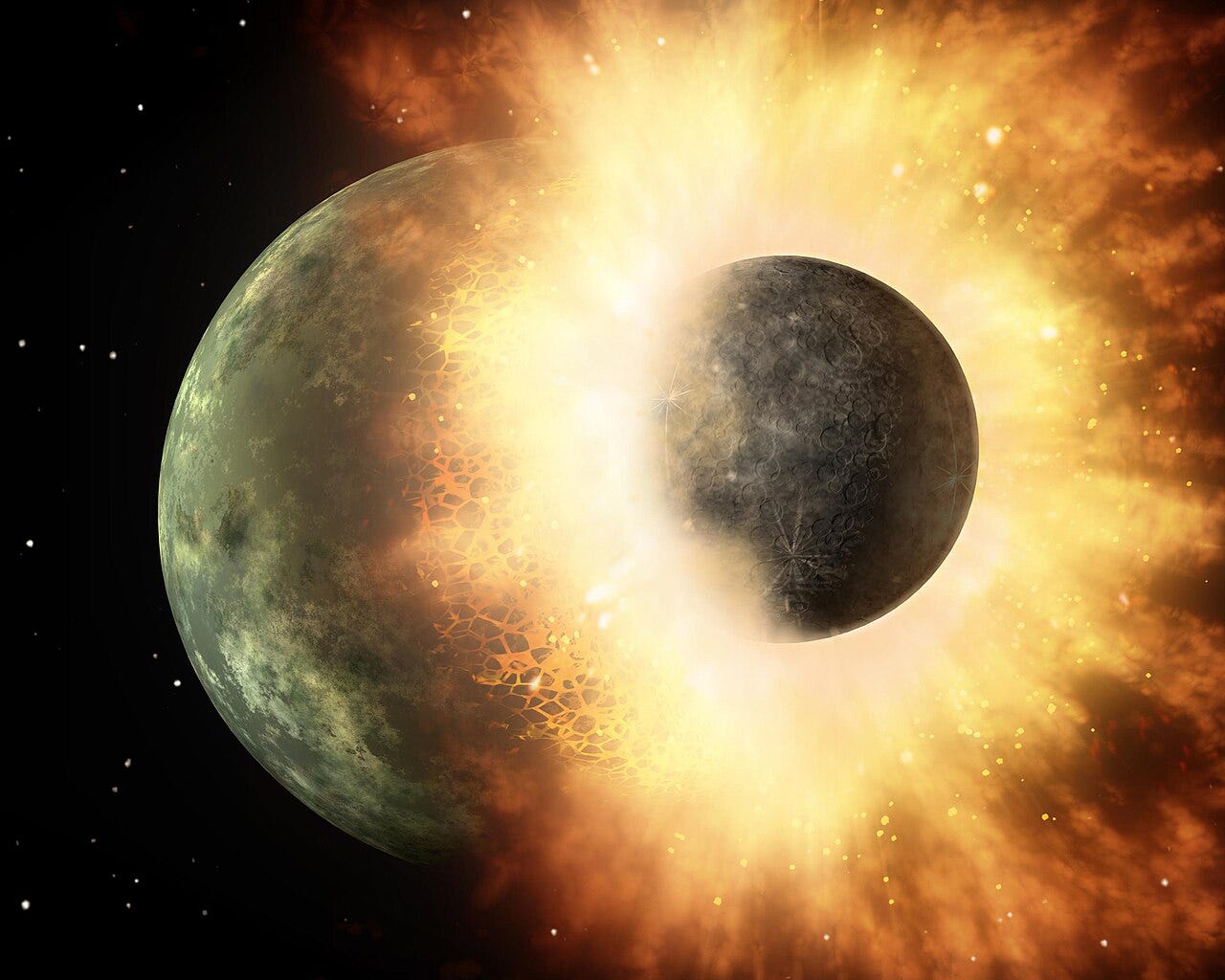
Figure 6
This new Moon orbited about a tenth of the distance that it does today. As one might expect, there are “a few unresolved problems”(47) with this hypothesis, one of which is that – surprisingly, at least to the brainiacs – the Apollo lunar samples found no trace of Theia-like compounds, but instead “carried an isotopic signature identical to earth rocks.”(48)(49) Had we known at the time, we may (between us) have been able to offer our own bespoke theory as to why that should be, but NASA made do without us:
“To help resolve these problems, a hypothesis published in 2012 posits that two bodies – each five times the size of Mars – collided, then recollided, forming a large disc of mixed debris that eventually formed the Earth and the Moon.”(50)(51)
Probably for the best, as what I had in mind didn’t sound a lot like that. NASA seems like a fun place to work, somewhere where one can give full rein to the creative impulse. And, in truth, that hypothesis isn’t notably more outlandish than most of the others in the realm beyond science. Of course, in typical fashion, it doesn’t survive cursory scrutiny, as the maths is all wrong. The Moon is receding from Earth at around 4cm per year, although the rate would have been faster previously. This ought to be a substantial problem:
“The moon could never have been closer than 18,400 km (11,500 miles), known as the Roche Limit, because Earth’s tidal forces...would have shattered it. But even if the moon had started receding from being in contact with the Earth, it would have taken only 1.37 billion years to reach its present distance...far too young for evolution...”(52)(53)
But expecting mere bagatelles like that to glitch the Matrix would be hopelessly naïve, even though there are a number of red-pilled scientists calling foul, noting that “in no other field of physics would this continual recourse to new hypothetical objects be accepted as a way of bridging the gap between theory and observation.”(54) As with other narratives that are too fundamental to relinquish, simply ignoring such criticism and reprinting the textbooks are effective tactics. The supertanker will not be turned around unless those on the bridge desire it.
There are other obvious problems with the ageing criteria. The quasars that are supposed to be reliable indicators of the BBT, particularly the hypothesis that “all stars and galaxies result from the early big bang universe”,(55) are nothing of the sort. Nor are those with large redshifts necessarily distant – instead, they are associated with parent galaxies which exhibit much smaller redshifts, having been ejected by same. They are also found in clusters of two (or multiples of two), for some reason.(56) So, not only is Hubble’s cautious approach to the redshift=distance paradigm vindicated, the assumption that all matter had its genesis in the Big Bang is also demolished as some quasars are recent creations. And, without a pristine Hubble’s Law, the ageing equation cannot be made to work.
Then there’s the comet problem. According to the guardians of the dogma, they are products of a young universe and should no longer exist, because they lose mass every time they pass the sun as they are composed of ice, dust and small rocky particles. Yet, as of five years ago, there are 4,584 known comets (57) and, in 2010, the Hartley 2 comet was photographed as it passed and was seen to be spewing snow into space and losing material rapidly.(58) It didn’t look old, at all. The highbrows are discombobulated:
“For starters, its nucleus contains and abundance of carbon dioxide...This is a volatile material...it burns easily...and so scientists would expect much more of it to have away on the 4.5 billion years since the comet formed along with the rest of the solar system.”(59)
One black swan, remember? Then there are blue stars, the biggest and brightest because they burn their nuclear fuel fast – very fast, in a maximum of ten million years. Yet there they are, plenteous in spiral galaxies such as the Milky Way and others.
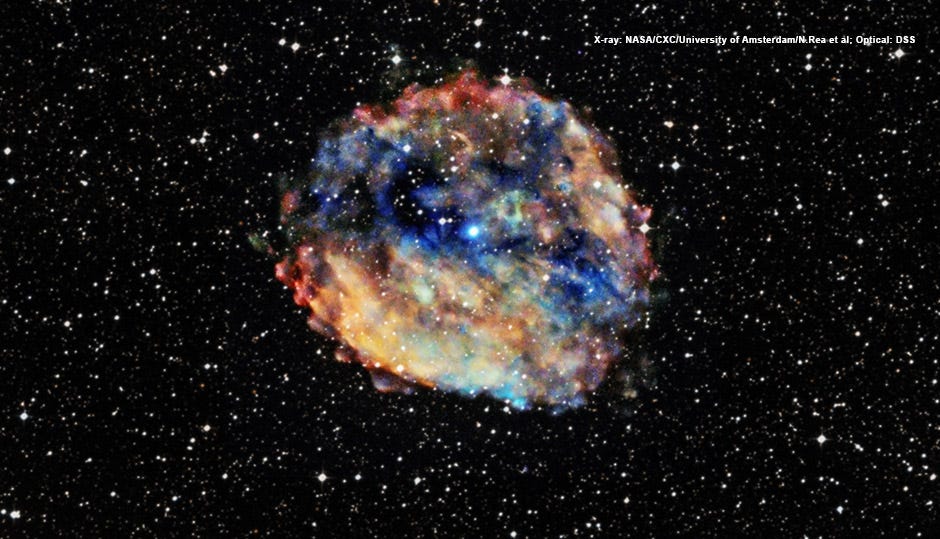
Figure 7
The men of erudition get around this by assuming that these stars were formed more recently than the rest of the galaxy although, as is now an ongoing theme, nobody has ever observed such a process, nor is there a viable mechanism according to the thesis.(60) The globular clusters of stars that orbit the centre of galaxies also defy explanation as they should have emptied in two million years, at most. The pedagogues allow that this ‘retention problem’ is a “long-standing mystery”,(61) although, perhaps, it wouldn’t be so puzzling if the BBT guardrails were to be dismantled.
There might then be a way of explaining why ‘mature’ galactic clusters, of the type that are only supposed to exist close-in, can also be found in deep space.(62) Another method of dating, whilst seemingly sensible, is also something of an omnishambles:
“Crater-count dating seems perfectly logical: the more craters, the older the landscape. It assumes, however, that impactors arrive at a roughly steady rate and produce one crater per hit.”(63)
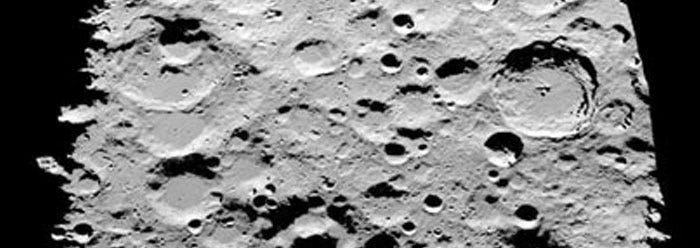
Figure 8
But secondary craters are also formed, from the debris of the initial impact. Lots of them – in fact, the vast majority. And, “without a way to reliably identify secondary craters, only subjective inferences can be made about the history of a surface.”(64) Damn and blast. Foiled again. Another Jenga piece teased out from low down. A reluctant acceptance by at least some of the double-domes that any dates derived from this methodology could be “off by orders of magnitude.”(65)
I intend to limit myself to one final field of inquiry, concerning the shape of the universe and our position within it. BBT, of course, insists that our galaxy was formed after 9.3 billion years of history and a visual representational would look something like Figure 9, with us about a third of the way out along the timeline. But not a third of the out towards the surface of the ‘balloon’. Contrary to popular belief, the theory the boffins favour cannot tolerate a centre.
“They picture the galaxies like grains of dust all over the surface of the balloon. (No galaxies would be inside the balloon.) As the expansion proceeds, the rubber (representing the fabric of space itself) stretches outward. This spreads the dust apart. From the viewpoint of each grain, the others move away from it, but no grain can claim to be the unique centre of the expansion. On the surface of the balloon, there is no centre.”(66)
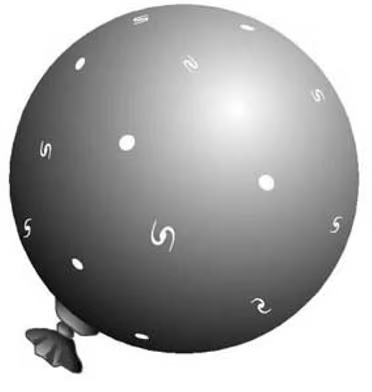
Figure 9
We are told that the universe is still expanding. We are also told that there is nothing special about Earth’s position within it, although our galaxy alone is estimated to contain a hundred thousand million stars, not to mention the millions of other galaxies, and we have yet to find a single one with signs of life. But let’s leave that aside for the moment and deal with a separate problem, which is that the universe is supposedly expanding at different rates, depending on where the telescope is trained.
Poor old Hubble has posthumously gotten his name attached to another ‘conundrum’ – the Hubble Tension. The James Webb and Hubble space telescopes do not return the same measurements. The leader of the study that confirmed this appears to be one of life’s foremost optimists:
“With measurement errors negated, what remains is the real and exciting possibility we have misunderstood the universe.”(67)
It seems that the problem arises from comparing and contrasting two different methods of measuring the expanding universe, both of them previously thought to be infallible. However, they produce different numbers – 67 kilometres per second per megaparsec (don’t ask) as against 74.(68) My impression is that a resolution of this conflict is being postponed, because it would involve a compromise that the intelligentsia are unwilling to make, namely that the observed speed of light is not as constant as they insist. The Webb telescope slices through the cosmic dust in a way that the Hubble does not.(69)
At some point, perhaps, the cosmological community will swallow its pride (if it absolutely has to) and slap another patch on the BBT. But there are bigger issues incoming, concerning more fundamental questions – such as ‘is the universe even expanding?’ and ‘is our galaxy at the centre of the universe?’, a centre that we are told doesn’t exist.
It will be recalled that, over the past couple of decades, intergalactic distances have not been observed to increase.(70) But, as we are continually reminded, the cosmogonists’ finite universe is expanding, according to BBT. And, in fairness, the theory fits some observations, notably providing an explanation for why the universe is not collapsing under its own gravity. But it also tells us that, in a universe that is expanding, distant objects should appear fainter, but bigger; the old redshift argument again. The surface brightness should decrease with distance. That isn’t what we ordinarily observe:
“In the space around us, on Earth, in the Solar System and our Milky Way Galaxy, as similar objects get farther away, they look fainter and smaller. Their surface brightness, that is the brightness per unit area, remains constant.”(71)
And it’s not what studies of both close and distant galaxies reveal. A group of heretics decided to test the theory, rather than run cover for it, and discovered that the surface brightness of both near and distant galaxies is identical. Pushing their luck still further, they decided to dump on the redshift=accelerated expansion of the universe and found that, whilst the redshift to distance correlation was sound, acceleration was contraindicated.(72) At which point, they came over all diplomatic:
“It is amazing that the predications of this simple formula are as good as the predictions of the expanding universe, which include complex corrections for hypothetical dark matter and dark energy.”(73)
I get the feeling that they didn’t find it particularly amazing at all; but delicately put, nonetheless. They channelled their inner Hubble, speculating that some other phenomena caused redshifting as light travelled through space. Plainly put, the data predicted a non-expanding universe to an accuracy of a few per cent.
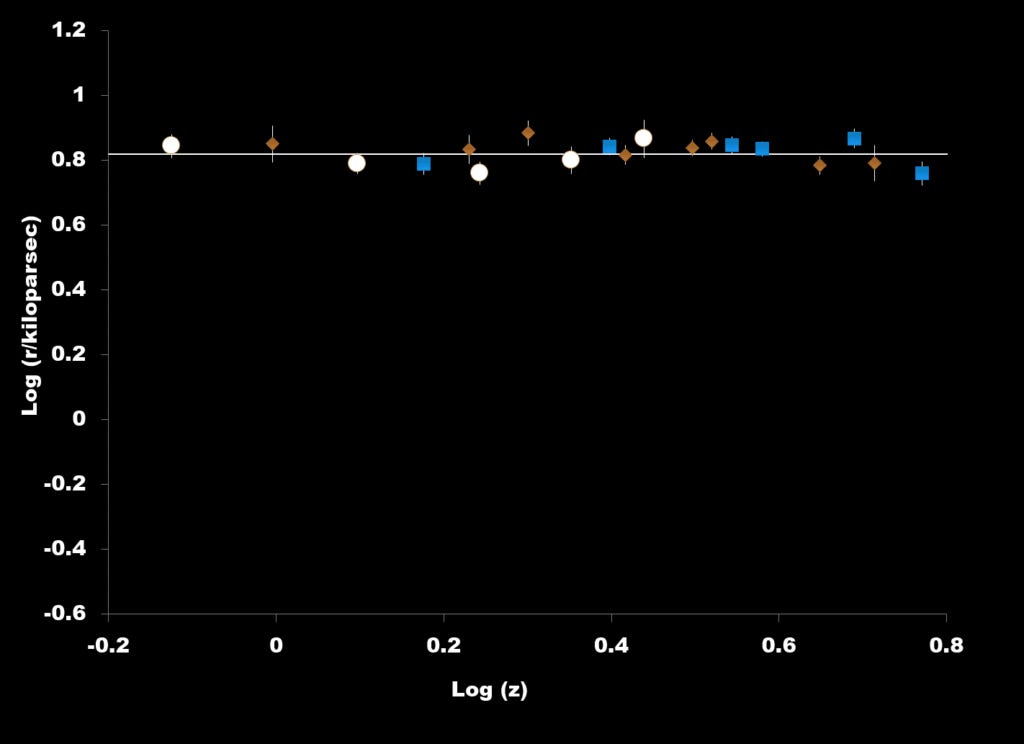
Figure 10
This possibility should no longer be that much of a surprise, in the light of all the issues that I have raised with the BBT. If it’s not a sound explanation for the universe, then there is no longer an automatic presumption that the universe is expanding:
“The simple non-expanding Euclidean universe fits most data with the least number of assumptions...it is apparent that there are still many unanswered questions on cosmology...”(74)
Not that you’d know it if all you did was listen to the court cosmologists, which we have had to do through a process of osmosis. In their telling, the science is settled – all that’s left are a few ‘anomalies’, which are only addressed if they can come up with some kind of formula or hypothetical that isn’t necessarily confined to the realm of the possible. Otherwise, they rely upon Greek symbols and our ignorance, which they have fostered.
I shall leave you with one further conundrum; the location of our galaxy in relation to the universe. In more innocent times, when man was thought to be God’s creation, the Earth was held to be at the very centre of the universe. Stephen Hawking, he of wheelchair and voice generator fame, claimed that the universe is spatially homogenous – that, at all junctures, “space is completely filled with matter-energy.”(75) He said this because, from our perspective, the universe “looks pretty much the same in all directions”(76) and the alternative hypothesis - “that we are located near a very special point” -(77) is considered unconscionable by the mavens. It is preferable, therefore, to insist that it would all look the same in every direction, no matter where we were in the universe.
However, those pesky redshifts swim into focus, once again. You will recall that rather than them being evenly distributed, they are grouped, or quantized concentrically around us. Something like this.
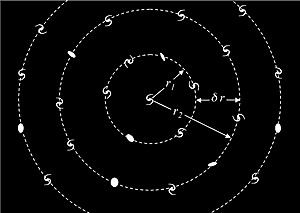
Figure 11
Not exactly like that – it’s not that neat – and although the distance interval between each shell is around a million light years, several different intervals also exist.(78) For a moment, then, let’s discard Hawking’s ideological guesswork, and assign to the observations a meaning that ought to have been nearer the top of the list of possible explanations – namely, that the universe does have a centre.
And from the exact centre, the distance groups would present as (a) in the following figure. But if we were two million light years from the centre (the observable universe is alleged to be 46.5 billion lights years in radius), we would not be able to distinguish the quantized redshifts (b), as they would be lost in the background noise.
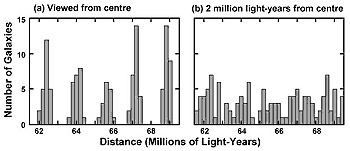
Figure 12
Because we can see them in this manner, in all directions and at great distances, it follows that we aren’t located at some random place on the skin of the balloon, but that we are central. In fact, the calculation is that our home galaxy is somewhere between 120,000 light years and 1.6 million lights years from the centre of the universe.(79) Apparently, the odds of us being that close to the centre of the cosmos randomly, is a little less than one in a trillion.(80) In other words, the data suggest that we are living in a galactocentric universe.
Not geocentric, which would imply that the Earth is at the exact centre and motionless, as our galaxy does appear to be in motion. But what ought to be the working hypothesis explaining redshift quantization – that the universe “has a unique geometric centre very near our own galaxy, the Milky Way” -(81) is almost completely ignored by the omniscient ones, who would prefer to continue invoking unknown physical processes instead.
And it’s this knee-jerk tendency that first aroused suspicion, as it is to be found all over the BBT. That and a corresponding refusal to entertain the possibility that any other explanation possesses a scintilla of credibility – the same dynamic that we find across every approved narrative. The theory and ‘science’ do not occupy the same postcode:
“The response of most cosmologists to this growing body of evidence has, unfortunately, not been to decide the Big Bang theory has been falsified, but to add new “parameters” and hypotheses... Each contradiction with observation is taken as a mere “anomaly” that does not undermine the theory as a whole. Strong peer pressure is applied against many of those who question the theory.”(82)
‘Twas ever thus – with regard to cosmology specifically, the ‘truth’ has undergone many a revision, from Ptomely, Copernicus (and Galileo), Newton and then Einstein. Ideology has always played an important role and new kids on the block have usually endured repeated beatings before their grudging acceptance. But the atheistic world view will not be surrendered lightly, or at all, and that is what’s really the driving motivation for the slavish devotion to the BBT. As Upton Sinclair had it:
“It is difficult for a man to understand something, when his salary depends on his not understanding it.”(83)
So, as with evolutionary theory, the BBT has very little going for it. It’s another classic example of unscientific endeavour but, because it’s the prevailing orthodoxy, it gets free pass after free pass:
“The Big Bang itself somehow gets away with going against the laws of causality, probability, conservation, entropy and even common sense.”(84)
Ordinarily, of course, tinkering with a working hypothesis when new evidence comes to light isn’t a problem – that’s exactly what you’d hope for, provided the evidence doesn’t hole it below the waterline. But cobbling together a series of fixes that fit no known natural laws – whilst simultaneously lauding uniformitarianism – and slapping them on a theory that is equally evidence-free without even attempting to explore alternatives, is clearly dishonest. So, the third part of this series will tentatively introduce a few areas of interest that may be under-reported, the better to inform your own thinking.
Citations
(1) https://christiancourier.com/articles/the-big-bang-theory-vs-gods-word
(2) https://creation.com/en/articles/secular-scientists-blast-the-big-bang
(4) Ditto
(5) https://www.icr.org/article/origins-breakthroughs-2010-astronomy
(6) https://www.icr.org/article/cosmic-bubbleland
(7) Burbidge, G., Why Only One Big Bang?, Scientific American 266(2):120, February 1992 | doi:10.1038/scientificamerican0292-120.
(8) https://creation.com/en/articles/is-there-evidence-for-expanding-universe
(9) https://creation.com/en/articles/antimatter-missing
(10) Ditto
(11) Lewis, G. and Barnes, L., A Fortunate Universe: Life in a Finely Tuned Cosmos, ch. 6, Cambridge University Press, 2016.
(12) https://creation.com/en/articles/antimatter-missing#forwardref-2
(13) Smorra, C., cited in Osborne, H., The universe should not actually exist, CERN scientists discover, newsweek.com, 25 October 2017.
(14) Weinberger, L., Whose god? The theological response to the god-of-the-gaps, J. Creation 22(1):120–127, 2008.
(16) https://creation.com/en/articles/dark-matter-and-a-cosmological-constant-in-a-creationist-cosmology
(17) https://creation.com/en/articles/dark-matter-unknown-god-carmelian
(19) https://creation.com/en/articles/why-look-for-new-theory-of-gravity-if-big-bang-cosmology-is-correct
(20) https://www.popularmechanics.com/space/deep-space/a60454807/big-bang-alternative-theory/
(21) https://www.icr.org/article/geocentricity-creation
(22) https://medium.com/@glennborchardt/why-the-universe-is-not-expanding-e7b9a8a55c5a#_edn2
(24) https://medium.com/@glennborchardt/why-the-universe-is-not-expanding-e7b9a8a55c5a#_edn2
(25) https://creation.com/en/articles/quasars-defy-big-bang
(26) https://creation.com/en/articles/hubble-hubble-big-bang-in-trouble
(27-28) Ditto
(30) Ditto
(31) https://ieeexplore.ieee.org/document/4316620/
(32) https://www.space.com/25126-big-bang-theory.html
(33) https://answersingenesis.org/astronomy/starlight/does-distant-starlight-prove-the-universe-is-old/
(34) https://creation.com/en/articles/dismantle-the-big-bang-and-rediscover-gods-universe
(35) https://answersingenesis.org/astronomy/starlight/does-distant-starlight-prove-the-universe-is-old/
(36) https://www.popularmechanics.com/space/deep-space/a44050735/the-universe-is-mostly-empty-space/
(37-38) Ditto
(39) https://www.space.com/end-of-einstein-space-time
(40) https://creation.com/en/articles/age-of-the-earth
(41) https://en.wikipedia.org/wiki/Age_of_the_universe#Observational_limits
(42) https://creation.com/en/articles/age-of-the-earth
(43) https://creation.com/en/articles/planet-formation-chaos-theory
(44) Ditto
(45) https://www.icr.org/article/astronomers-speak-our-solar-system-special
(46) https://en.wikipedia.org/wiki/History_of_Earth#Solar_System_formation
(47) https://en.wikipedia.org/wiki/Origin_of_the_Moon
(48) Ditto
(49) Wiechert, U.; Halliday, A. N.; Lee, D.-C.; Snyder, G. A.; Taylor, L.A.Rumble, D. (October 2001). “Oxygen Isotopes and the Moon-Forming Giant Impact”. Science. 294 (12): 345–348.
(50) https://en.wikipedia.org/wiki/Origin_of_the_Moon#cite_note-nasa1-1
(52) https://creation.com/index.php?option=com_content&view=article&id=764#receding
(53) Don DeYoung, ‘The Earth-Moon System’, Proc. Second International Conference on Creationism 2:79–84, 1990.
(54) https://creation.com/en/articles/secular-scientists-blast-the-big-bang
(55) https://creation.com/en/articles/quasars-associated-with-galaxies
(57) https://minorplanetcenter.net/
(58) https://www.icr.org/article/origins-breakthroughs-2010-astronomy
(59) https://www.space.com/11989-quirky-comet-hartley-2-solar-system-theories.html
(60) Lisle, J., Blue stars confirm recent creation, Acts & Facts 41(9):16, 2012; icr.org.
(61) Pfahl, E., Rappaport, S., and Podsiadlowski, P., A comprehensive study of neutron star retention in globular clusters, Astrophysical Journal 573:283–305, 2002; | doi:10.1086/340494.
(62) https://www.icr.org/article/origins-breakthroughs-2010-astronomy
(63) https://www.icr.org/article/crisis-crater-count-dating
(64-65) Ditto
(66) https://creation.com/en/articles/our-galaxy-is-the-centre-of-the-universe-quantized-redshifts-show
(67) https://www.eurekalert.org/news-releases/1037233
(69) https://www.eurekalert.org/news-releases/1037233
(71) https://www.sci.news/astronomy/science-universe-not-expanding-01940.html
(72) https://www.worldscientific.com/doi/abs/10.1142/S0218271814500588
(73) https://www.sci.news/astronomy/science-universe-not-expanding-01940.html
(74) https://creation.com/en/articles/expanding-universe-2
(75) https://creation.com/en/articles/our-galaxy-is-the-centre-of-the-universe-quantized-redshifts-show
(76) https://creation.com/en/articles/our-galaxy-is-the-centre-of-the-universe-quantized-redshifts-show
(77) Rindler, W., Essential Relativity: Special, General, and Cosmological, Revised 2nd edition, Springer-Verlag, New York, p. 135, 1977.
(78) https://creation.com/en/articles/our-galaxy-is-the-centre-of-the-universe-quantized-redshifts-show
(79-81) Ditto
(83) https://www.goodreads.com/quotes/21810-it-is-difficult-to-get-a-man-to-understand-something
(84) https://www.icr.org/article/cosmic-bubbleland
Figure 1 https://cosmosatyourdoorstep.com/wp-content/uploads/2023/01/milky-way-galaxy-alfred-pasieka.jpg?w=893

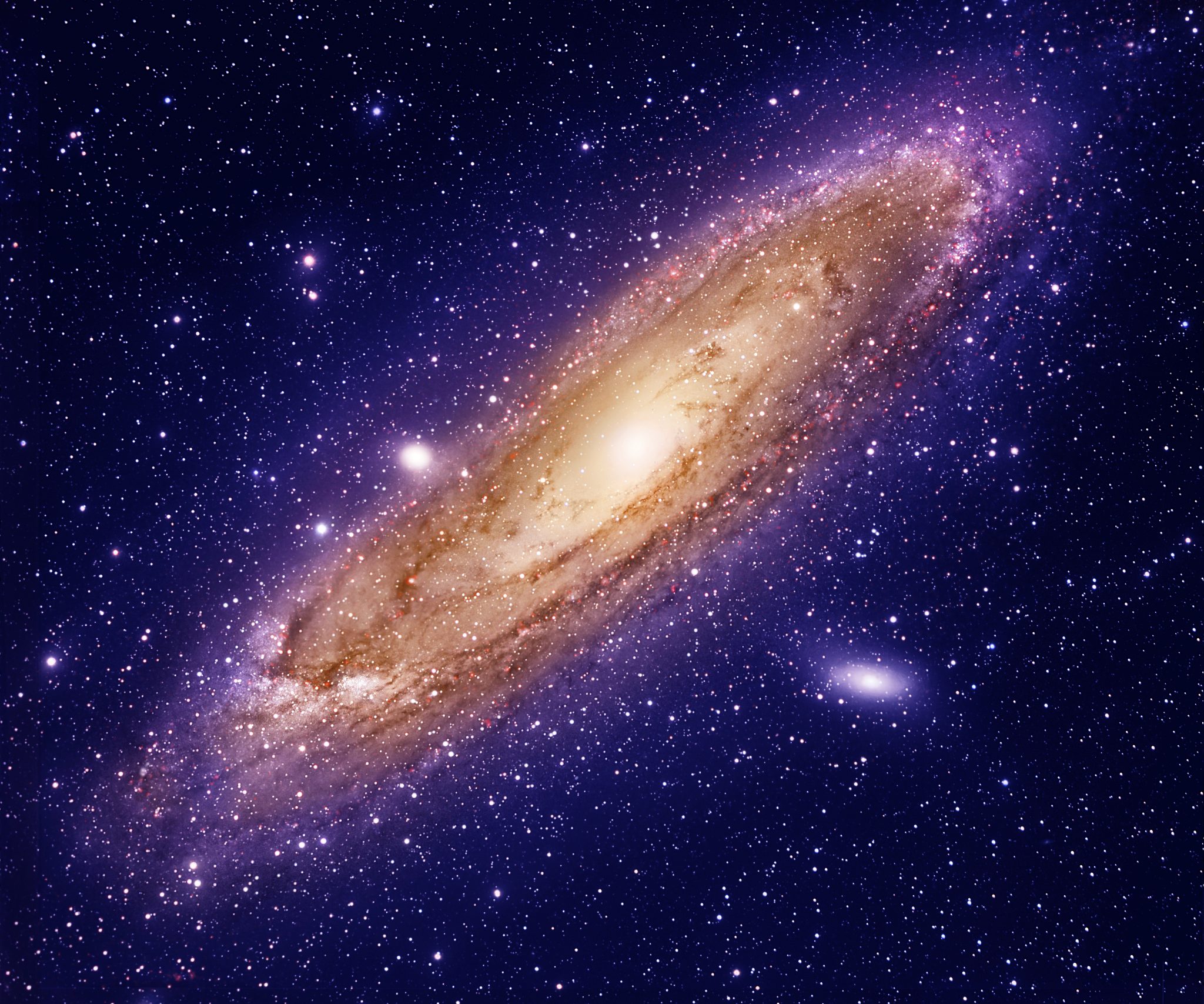
Figure 3 https://www.popularmechanics.com/space/deep-space/a44050735/the-universe-is-mostly-empty-space/
Figure 4 https://lovinthings.com/wp-content/uploads/2019/02/Big-Bang-Timeline.jpg

Figure 5 https://en.wikipedia.org/wiki/Age_of_the_universe#Observational_limits
Figure 6 By NASA/JPL-Caltech - http://www.nasa.gov/multimedia/imagegallery/image_feature_1454.html, Public Domain, https://commons.wikimedia.org/w/index.php?curid=8626942
Figure 7 https://creation.com/en/articles/star-witnesses-young-creation
Figure 8 https://www.icr.org/article/crisis-crater-count-dating
Figure 9 https://creation.com/en/articles/universe-shape
Figure 11 https://creation.com/en/articles/our-galaxy-is-the-centre-of-the-universe-quantized-redshifts-show
Figure 12 Ditto