
Digital Everything
Can It Be Done?

“The difference between a welfare state and a totalitarian one is...a matter of time.” Ayn Rand
The recent shutdown of the US government prompted rivers of crocodile tears from the Leftists who caused it, most of them spilled on behalf of those poor unfortunates who rely on SNAP (Supplemental Nutrition Assistance Program) benefits to get by. Regrettably – for Democrats – the spotlight might have been better shone elsewhere, as Americans learned that the temporary food stamps programme was nothing of the sort, as some recipients had been relying on it for up to thirty years.(1) Still, at least they were citizens. It also became clear that the blue states, in particular, were colluding in multi-billion dollar fraud, a circumstance that should have been obvious when SNAP funding ballooned by 40% under the Biden regime, a time of record illegal immigration.(2)
The 42 million availing themselves of that benefit turned out to the tip of the welfare iceberg. Food banks are catering to 50 million, although one would expect a substantial crossover between the two cohorts.(3) However, as I alluded to previously (in Who Holds The Whip Hand?), the welfare system in its entirety is ‘broken’ - otherwise known as doing exactly what it has been designed for - a revelation that may not be shared in polite company. Lots of people get free stuff, stuff which those working 60-hour weeks cannot afford. For tens of millions of Americans, there is no financial reason to knock themselves out, because the welfare state actively discourages hard graft:
“And the system is designed to prevent them from escaping. Every dollar you earn climbing from $40,000 to $100,000 triggers benefit losses that exceed your income gains. You are literally poorer for working harder.”(4)
A worker earning $65,000 a year takes home an income that would generate the same rewards as making $30,000 and relying on the state to provide the remainder in benefits.(5) So, workforce participation rates are shockingly low. 36% of the working-age population has opted out; they’re not employed and they’re not looking to be – already around 102,500,000 people living on what is effectively UBI.(6) I found that statistic staggering.
Strangely, these truths don’t often see the light of day, but it’s why the federal mandatory outlay purely allocated to welfare programmes was just under $4 trillion in 2024,(7) or 80% of federal income.(8) Money taken from individual taxpayers totalled $2.4 trillion, so companies and corporations bridged the gap.(9) There’s a certain irony in the fact that the state’s coddling of the wilfully unemployed is only possible because of taxes paid by productive businesses.
A direct effect of this intentional snafu is a vast tribe of citizens (and, inevitably, non-citizens) who are wholly dependent on government handouts. This is, of course, not unintentional. But the US is not alone – the welfare state is deeply embedded across the West. Perhaps at least some regimes were founded with good intentions, but given that most were the brainchilds of Leftists, perhaps not. The modern concept of taxation is surely, at its core, simply a way for the state to reserve to itself the right to redistribute an individual’s property as it, not the individual, sees fit, to the detriment of all:
“If, instead of teaching a man to fish, you decree that he is entitled to another man’s fish and you have the ability to enact and extract, then you control both men. Both become supplicants, for different reasons, but supplicants nonetheless.”(10)
Welfare systems that are light years removed from a desire to “provide safety nets for the most vulnerable in society” are the inevitable result,(11) and the culture of dependency that is engendered causes an erosion in the tax base and enormous national debts. In some Western countries, there are now “multiple generations of families who have never worked,”(12) not because they couldn’t, but because they didn’t need to. Welfare states are also migrant magnets, many of whom have no interest in contributing, but are more than willing to milk the system.
The French are busy rearranging deckchairs and the German band is right there beside them, playing on as the ship goes down. France has endured 68,000 corporate insolvencies over the past twelve months and the economy is on its knees,(13) but the political class holds fast to the illusion that they can rescue their welfare system by running up the national debt. Gallic logic contends that maintaining the largest social budget in the EU is compatible with one of the lowest retirement ages, 62, and a work culture that is not famed for its industriousness.
Meanwhile, Germany’s newish Chancellor, “an unforced error factory”,(14) pledged fiscal responsibility on the campaign trail, but instead abandoned the debt brake and borrowed just under a trillion euros.(15) He has his own insoluble pension cataclysm to ignore; in 1960, six German workers supported each pensioner, but that’s currently down to two and by 2050 it will have stabilised at 1.3.(16) In a logical world, taking on yet more debt will soon be the only way of squaring that particular circle.
However, some countries are clearly motivated by more than misplaced compassion or a Messiah complex – they are actively widening the net. The UK which, under Starmer, increasingly resembles a failed state, is once again leading the charge. The furlough policies of his predecessor, the effete Sunak, set the scene during the counterfeit pandemic; the state paid 80% of workers’ salaries whilst confining them to quarters for three months. Except it lasted, on and off, for eighteen months and doled out £70 billion of taxpayers’ money to 11.7 million people, provided they sat at home and did nothing.(17)
To the surprise of nary a single student of human nature, the message that it sent – that people, like the banks, were now ‘too big to fail’ – exacerbated the dependency culture, resulting in a current workforce that is still smaller than it was pre-’pandemic’. A pattern is discernible:
“One of the unintended consequences of the welfare state has been the erosion of personal responsibility and traditional family support systems. In the past, families took care of their elderly, supported their struggling members, and worked together to overcome hardships. But with government welfare available, many individuals no longer feel obligated to support their loved ones.”(18)
I take issue with the word ‘unintended’, but the general point is well made. The state’s PIP scheme (personal independence payment, the bastard child of the unselfconsciously titled Universal Credit Act of 2025) permits one-in-eight 16-24-year-olds to avoid both education and employment,(19) and the latest budget cobbled together by Rachael from Accounts twists the knife. She hiked taxes by £26 billion and also abolished the two-child benefit cap, disproportionately benefitting 350,000 foreign-born families who have never paid into the system.(20)
A parent with three children, on combined benefits, ‘takes home’ income that can only be matched by a pre-tax salary of £71,000.(21) Rachael claims that her scheme will slash child poverty, but she knows that’s just another crock:
“Despite decades of welfare programs in the West, poverty has not been eradicated. In fact, in many cases, it has deepened. Welfare states create cycles of poverty where people rely on benefits for survival rather than seeking ways to become financially independent.”(22)
The observant amongst you will have noticed that the welfare states that I have described are clearly unsustainable in their current form. The moolah simply isn’t there. Yes, in the short term, money-printing can paper over the futility, but even that wheeze runs out of gas at some point, probably when the interest payments on the debt become too debilitating. There are, in truth, only three potential solutions; turbocharge the economy (by incentivising entrepreneurship, torching reams of oppressive regulations and binning Net Zero); reduce overheads; or take over the means of production.
I imagine that you won’t need to hazard any wild guesses in determining which option our leaders will inevitably alight upon at some point, although there will also be a soupçon of belt-tightening; which will not be accomplished by making hard choices, but by a managed decline in the number of supplicants. Which is a roundabout way of saying that the ‘useless eaters’ will be encouraged to cross the great divide as soon as humanly possible.
That particular campaign is going gangbusters throughout the West. Two-Tier Keir’s wake of fellow travellers are enthusiastically playing catch-up, attempting to make medical murder a thing and legalising abortion up to the point of birth.(23)(24) Eight European countries allow either euthanasia or assisted suicide (with another six eager to join them),(25)(26) and the Antipodes have recently come on board,(27)(28) but all must cede top-billing to the Canadians. The unremitting mission-creep of their MAiD programme is something else. Note the following sentence from Figure 1:
“The committee also suggested parents may not be consulted and wouldn’t need to consent to their child’s death via MAiD.”(29)

Figure 1
They are a very long way down the track; it must take a particularly virulent pathology to imagine that the state killing a child without the parents’ knowledge is acceptable. Other tricks of the trade include years-long waits for surgery or other forms of treatment, which result in feelings of despair, at which point the state steps in and offers a ‘medically assisted death’, or homicide to you and I.(30)
But, even then, I suspect that the conveyor belt is too sluggish. In the meantime, the state would need to get its hands on some plunder, and quickly, because if a universal basic income is in our future (and that’s a bigger ‘if’ than you might realise), the means of production will have to become socialised.
“Why socialism? Because socialists promise to care for the downtrodden, which will be every person left alive when AI achieves full robustness. AI in the hands of a socialist government will feed and house them, and will, of course, see that it’s done equitably.”(31)
Although the Technocrats intend to essentially usurp the power of the state and wield it for their own ends, so that would likely involve a hybrid system. Musk’s assertions that the “communist utopia...will be achieved via capitalism” and that humanoids will “make employment optional” obscure the nuts and bolts of what will actually happen if he gets his way.(32) Power and resources will be centralised in the hands of a smattering of oligarchs and they will (presumably) supplement the existing welfare system with their own bespoke version, or replace it altogether. There are some obvious problems associated with that scenario:
“The corporations promising “dividends” to the people they replaced are not offering freedom. They are manufacturing dependence. It is the same trap as state welfare; only now the state and the corporate elite operate in lockstep, forming a partnership that decides who eats and who doesn’t. A nation where citizens rely on the same entities that erased their jobs is not a nation of free men. It is a nation held hostage by its own technological masters.”(33)
There are, however, one or two minor logistical obstacles blocking the path to the sunlit uplands of our collective Shangri-La. The Tech Lords may have a flair for totalitarian philosophy, but they aren’t always the brightest bulbs in the chandelier. If we recall, most of the leading lights of the Technocracy cult got their start courtesy of the CIA, not because they are especially bright.
Some of the software that has made them filthy rich was developed in collaboration with the agency and, seemingly, gifted to them. The venture capitalists amongst them are an incestuous bunch, forever plumping each other up. In a competitive market, I’m not convinced that they would be stars, but billions in government contracts give the impression that there isn’t even a playing field, never mind one that’s level.
So, planning isn’t necessarily a first-order talent. Either that, or the Deep State has had trouble synching all the necessary components, because it’s apparent that, while the digital assets seem to be coming along just fine, the resources that will be necessary if they are to be maximally utilised are either in short supply or entirely absent. And these resources are fundamental to the project; money, energy and water. I think it reasonable to posit that nobody has any real idea how much of each will be required, except that it will be a lot. And by a lot I mean off the charts.
Large Language Models require an extraordinary amount of energy. Twelve months ago, Morgan Stanley estimated that the US would need at least 36GW of new capacity by 2028, to energise all the pie-in-the-sky data centres that have yet to be built. That’s a decent-sized shortfall.
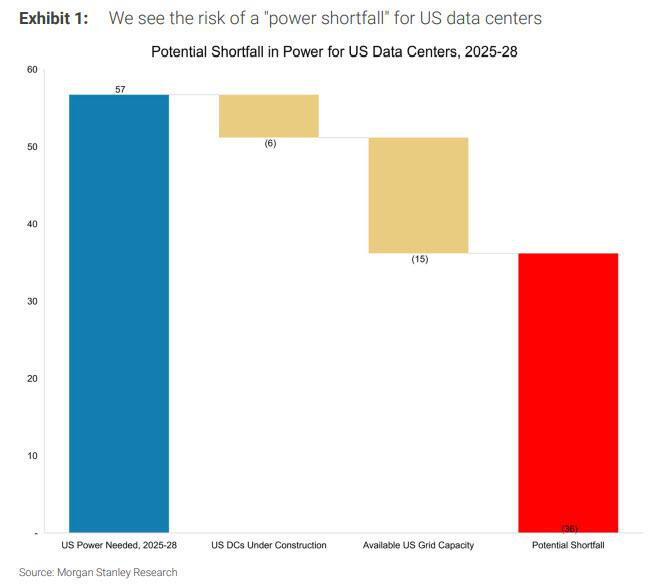
Figure 2
That figure is, however, a mere bagatelle. By 2032, there will be a need for an extra 100GW of additional energy.(34) That sort of requirement cannot be integrated into the existing grid without causing chaos and huge hikes in power prices for ordinary citizens. The proposed solution is for data centres to stay ‘behind the meter’, with their own off-grid power generators and the only way that might possibly be accomplished is via nuclear power - small modular reactors (SMRs), to be precise. As Jensen Huang, one of the world’s most polished snakeoil salesmen, told Rogan recently – in the process signposting what is probably the most compelling reason for the Tech Bros’ sudden enthusiasm for MAGA:
“[Trump] came into office and the first thing he said was ‘drill baby drill’...It saved the AI industry. I got to tell you, flat out, if not for his progrowth energy policy we would not be able to build factories for AI, not be able to build chip factories, we surely wouldn’t be able to build supercomputer factories...”(35)
As a sidenote; the capacity to weather the cognitive dissonance that surely exists in the American end of the scheme – particularly the Musk-adjacent, who mustn’t (at the very least) renounce their membership of the climate change cult, whilst being implicitly all-in on an immense energy build-out – gives the Tech Bros a huge advantage over the Euroweenies and the Brits, who cannot countenance the abandonment of their Net Zero fantasies.
The price of a kilowatt-hour of electricity is currently 33.8 cents in the UK, and between 20-30 cents in the largest European economies. In the US, it’s 8.1 cents (and it’s only 3 cents in China).(36)(37) That might actually be good news for the EU citizenship, as falling on their swords and admitting defeat is not a condition much found in Brussels or London. And without the extra energy, the full panopticon of digital control must surely be unachievable.
The Trump administration may well utilise the industrial diesel generators that already exist as emergency back-ups and which are located at existing data centres and other commercial sites. Apparently, that’s 35GW right there,(38) if the rules governing pollution are somehow circumvented. The SMRs aren’t likely to come on stream until the 2030s so, at the present time, the energy shortfall would seem to be a profoundly limiting factor.
As is water – data centres are savagely thirsty. In 2024, a single data centre in Iowa consumed a billion gallons of water, which was enough to supply all of Iowa’s residential water for five days.(39) I assume that an evaporative cooling system was in use, but there are closed loop systems that chill the water and recirculate it. However, the kicker is that this system requires even more energy. Hobson’s choice, then. Not to mention the water already consumed by the steam-generating power plants that provide that energy.
Each 100-word AI prompt is estimated to consume about a pint of water and the water demands of the existing centres are already impacting local communities.(40) Predictably, the Tech companies commissioning them are less-than-transparent about their environmental impact and go to some lengths to hinder attempts to rein their efforts in. They seem to be eyeing the Great Lakes area for their new builds, as it’s relatively cool and blessed with an abundant water supply. However, that supply currently caters for 40 million people and a $6 trillion regional economy. Quite what happens when vast new demands come online is currently unknown, but I suspect it won’t be good.
“But without a consistent and transparent way to track water consumption, society is flying blind. The public and government officials lack the complete information needed to make informed decisions about where to locate these facilities, how to regulate them, and how to plan for sustainability.”(41)
There’s also the ticklish problem of how to pay for it all. The data centres alone (across the globe) will cost nearly $3 trillion by 2028 and $6.7 trillion by 2030, around half of which will be debt – mostly private.(42)(43) But that takes no account of the money that will be required to build the aforementioned SMRs; that will need several trillion more, money which the private sector hasn’t been able to find down the back of the couch.
But no matter – most of the financing for the additional electricity will come from the Energy Department’s Loan Programs Office. Trump wants the US to break ground on ten large nuclear reactors by 2030.(44) A public-private enterprise, then. Taxpayers effectively financing Big Tech, whose data centres would be useless without the necessary energy – without ever being asked if they’re okay with it.
That’s if Big Tech is actually going to fulfil its own obligations. At present, the AI companies – with OpenAI and Nvidia to the fore – are fully invested in round-tripping, a strategy that would be identified as fraud and money laundering if conducted by a bank or an individual. Each deal further inflates the bubble, as press releases become currency:
“In simple terms, it’s when companies send money out the door through investments, purchases or partnerships, and then quietly receive it back through another channel. It makes activity and revenue look bigger that it really is.”(45)
To the untutored eye, these companies are playing stupid games and will, eventually, win stupid prizes.. The trillions needed to fill the funding gap for data centre build out will still be insufficient unless GenAI actually begins to turn a profit, something which is has signally failed to do, thusfar. Of the initial $2.9 trillion, less than half will be needed to buy the land, construct the buildings and fit them out - $1.6 trillion will be spent on GPUs from Nvidia and others.(46)
Another tiny problem presents itself – a GPU’s useful lifespan is one to three years, because the thermal stress is simply too high.(47) That’s to say nothing of the potential technological obsolescence also driving replacement cycles. However, the chips are paid for over a five year period, so actual useful life is around half the accounting life. Back-of-a-fag-packet maths points to the possibility of another multi-trillion dollar funding gap in the not-too-distant, whilst the Tech Bros wander around with pencils up their noses and underpants for hats.
As it is, “the base case for revenue growth is for 1,900% revenue growth by 2028.”(48) Is that so? A sensible person might be devoting a little time to working out how it is that GenAI can make any profit at all. No matter how creative the accounting is, with CapEx of that magnitude there is a need for a giant revenue stream. That’s providing it does what it says on the tin. Which it doesn’t. At present, no AI company is anything other than a money pit.
Their CEOs and the uncritical boosters in the media will claim that all that is going to change – if they are even challenged, which they’re not – because the Holy Grail is just around the corner and it’s called AGI; Artificial Generative Intelligence (the Tech Bros get to invent their own nomenclature). You see, it’s simply a matter of size. Bigger is better. Their contention is that they, like Jim Kirk, just need more power:
“For Mr Musk and his GenAI fellow travellers, the biggest hurdle on the road to AGI is the lack of computing power (installed in data centers) to train AI bots which, in turn, is due to a lack of sufficiently advanced computer chips.”(49)
Musk and Altman insist that we’ll be cooking on gas by 2026 at the latest.(50) Their professed belief is that AGI will make workers and firms exponentially more productive, which will boost corporate revenues, thus allowing an equitable distribution of surplus profits. But AGI itself is yet another of those notions that none of its proponents seem to want to explore in much depth. The general idea is a classic accelerationist proposition:
“Roughly, the idea is that an AGI model can generalize beyond specific example found in its training data [like humans]...by learning from experience and changing methods when needed...AI bots will be telling us how to develop new medicines to cure cancer, fix global warming, drive our cars and grow our genetically modified crops...AGI would transform not just the economy and the workplace, but also systems of health care, energy, agriculture, entertainment, transportation, R&D, innovation and science.”(51)
At least, that’s what they say they believe. Maybe they do, maybe they don’t. Altman’s GPT-5, launched this August and allegedly a notable way-station on the yellow brick road was, instead, a hot mess. ‘Hallucinations’ proliferated, at a rate of one-in-ten when hooked up to the internet, and half the time when logged off. The core premise – that “building ever-larger models and ever-larger databases” was part of the solution - took another hit, appropriately, as it has never been anything more than a wholly unproven theory, backed by no evidence whatsoever.(52)(53) Which is problematic because the existing AI models have limitations that are far more severe that their supporters are willing to acknowledge. There’s a reason for that:
“It is becoming more widely understood that LLMs are not constructed on proper and robust world models, but instead are built to autocomplete, based on sophisticated pattern-matching.”(54)
Consequently, they can’t play chess properly and, even when trained on the entire physics canon, cannot detect the principles that undergird their training data.(55) And, despite Musk’s habitual obfuscation, larger AI models are not better, either – they’re worse.(56) They can’t even find the relevant information from the net – instead, they just make shit up. That’s because they are trained to guess, rather than admit that they’ve come up empty.(57)
Companies that jumped the gun and and believed the AI hype-machine found that they’d jumped the shark instead. 95% of generative AI projects in companies don’t enhance revenues, because tools like ChatGPT “stall in enterprise use since they don’t learn or adapt to workflows.”(58) Laid-off workers are getting re-employed. Even advanced AI models are still no match for human coders,(59) and those who used AI assistance tools were nearly 20% slower than when simply doing it all themselves.(60) There is, then, currently no jobcopalypse and, by rights, there never will be, provided we accept a particular framing.
That framing relies on logic and good intentions, which means it’s automatically fallible, but if we properly assess the possibilities of AGI and then overlay them onto the entire spectrum of employment, there is no way that the algorithms can competently replace humans. Even I, a complete tenderfoot with regards to AI, can recognise that. As noted last time out:
“A-I does its thing by rapidly combing through the Internet to evaluate and seize information that you request. Increasingly, A-I colonizes the Internet with second-hand, third-hand, and so forth A-I-generated information. The more territory A-I seizes on the Web, and the more it trains itself on recursive feedbacks of its own garbage, the more distorted the output gets.”(61)
In this case, bigger is not better. AGI is a chimera, inasmuch as it’s never going to be capable of adequate decision-making. It cannot ‘think’, it cannot ‘learn’. The more slop it’s fed, the more out of shape it gets. An exponentially worse version of what currently exists may be around the corner, but that’s all. Yet – from the outside, admittedly - the Tech Lords seem to have managed to persuade Team Trump that the pursuit of AGI is vital to America’s future prosperity and national security and that they must get there before the Chinese.
However, as AGI is never going to happen, the sound strategy would have been to sit back and watch Xi squander billions on a castle in the air, whilst they went about improving what they’ve already got. If, of course, that’s what Xi has been doing, which it isn’t. He’s been focussed on using the AI that already exists,(62) and shaping it into a more efficient tool of control, which is what it’s good for – not for mimicking human thought, but for applying human-coded algorithms to defined circumstances and coming up with outputs that are designed in. Essentially, a process that problem solves in the same way that a calculator adds, subtracts and multiplies.
In a world in which only the fittest survive, we should, therefore, be left with the products that are already available and they are not profitable, nor will they ever be. Many AI products are
“...never going to be cost-efficient, never going to actually work right, will take up too much energy, or will prove to be untrustworthy. There are few real uses [other than] summarizing notes of meetings, generating reports and helping with computer coding.”(63)
Which is not to say that the Business Idiot class that latterly sits in boardrooms won’t try to stiff workers and clients alike by deploying AI products that aren’t fit for purpose, but that strategy isn’t pervasive, nor is it at scale - yet. So, what’s really going on? Are Silicon Valley’s very own Masters of the Universe hallucinating, like their models? Have they managed to persuade each other that the great jump to super-intelligence is actually going to happen, even when the entire concept is little more than a fever dream? I suppose it’s possible.
They give the impression that they are true believers, but that should be counterbalanced by what we know of their ideology and how they feel about us. They do, after all, cleave to the mantra that they should accelerate the “creative destruction of social, economic and political systems” (64) and they also believe that “people are, on average, not very bright”,(65) and that our “portion of sovereignty will be estimated with appropriate derision.”(66)
Could it be that they know that AGI is not viable and that the alleged pursuit of it is a sham? After all, their belief systems are not marbled with altruism, and creating a tool that could cure cancer would just result in more useless eaters. I can see AI’s ‘efficiency’ appealing to them, but they don’t need AGI for that. They just need enough grunt for a flawed algorithm that can rule over us, that it might administer a social credit score, calculate actuarial odds and refuse to offer car insurance and apply negative interest rates on dissidents’ bank accounts and so forth. Plus digital everything.
For that, they’ll need what they’ve already got, plus at least some new data centres, massive bandwidth (that’s where 5G comes in) and a supercharged national grid. If they can keep up the charade for long enough, perhaps that’s what they’ll get. Even the critics of the AI industry approach it from the perspective that Ellison, Altman et al are genuinely attempting this massive build-out; they all then point up the absurdity of the project, list the various ways in which it will fail and predict that the massive tech bubble – currently propping up the stock market and comprising half of US GDP –(67) will eventually pop, at which point there will some kind of Wall Street meltdown.
Just today, there was another report of private finance pulling out of a build with Oracle, the conclusion being that if the private sector is saying ‘no mas’ already, there is no way the tech cycle will be completed.(68) This ignores the fact that a nearly $3 trillion price tag already exceeds the total capacity of the credit and derivatives market in its entirety, so the data centres cannot be built and equipped using traditional financing. Thus, there are two possible scenarios; firstly, the true believers are as divorced from reality as the climatistas are and their project will crash and burn; or, secondly, that states themselves are going to bail them out, in addition to loaning them the funds to build the reactors and power stations.
We don’t have to guess in the case of the Americans. Silicon Valley’s very own ‘AI & Crypto Czar’, David Sachs, has Trump’s ear. In early November, he was promising that there would be no federal bailout for AI.(69) Less than three weeks later he had changed his tune – now special pleading was the order of the day.(70) The volte-face was completed by Trump’s Executive Order that same day, which reads like a wish-list for Silicon Valley. As is now par-for-the-course, the declarative statements justifying what follows are not backstopped by evidence. It might as well have been written by the terminally mendacious Biden cabal.
There’s the usual drivel about America being “in a race for global technology dominance in the development of artificial intelligence”, which means that “in this pivotal moment” (there’s always one of those to hand) “the challenges we face require a historic national effort, comparable in urgency and ambition to the Manhattan Project.”(71) Just briefly, before I set out what the president’s ‘Genesis Mission’ mandates, a quick reminder of what this effort is being applied to, for old time’s sake:
“You can add as many layers of intrigue and “reasoning” as you want, but Large Language Models cannot be trusted to do something correctly, or even consistently, every time.”(72)
Therefore, it doesn’t matter how many trillions of dollars of other people’s money Trump ploughs into AI, it can never be anything other than what it already is:
“Cheerleaders miss that LLMs do not reason but are probabilistic prediction engines. A system which trawls existing data, even assuming that is correct, cannot create anything new. Once existing data sources are devoured, scaling produces diminishing returns. Rather than fully generalisable intelligence, generative models are regurgitation engines struggling with truth, hallucinations and reasoning.”(73)
But, nonetheless, the plan involves merging the federal government with private sector AI firms. It’s not difficult to see what happens then – we’ll be treated to another smörgåsbord of guff, with phrases like ‘national security’ and ‘too big to fail’ given yet another airing. AI will no longer be (already isn’t) a speculative investment by the private sector; it’ll be a state-protected, publicly underwritten endeavour and the largest AI firms – Oracle, OpenAI and others, no doubt – will become part of the state furniture. The financial risk will no longer be worn by the markets alone, but by every US citizen in the here and now and in the future. All without any buy-in from those very same people and all for a technology whose only real function is to manage and control society.
So, that’s the play by the Technocrats. Private enterprise reversing into state enterprise. I would think that Trump imagines that the state gets to be the top, but I’m pretty sure that the Tech Lords don’t see themselves as bottoms. Remember this?
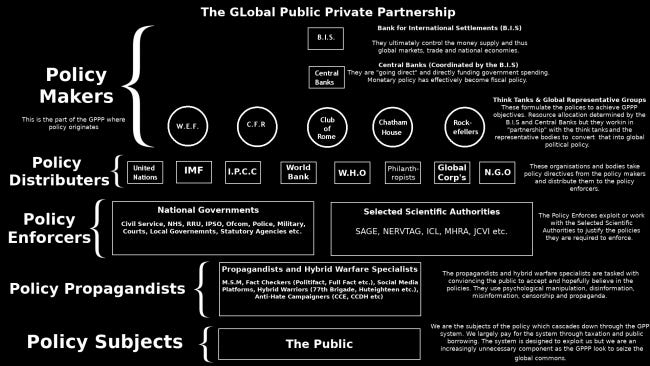
Figure 3
National governments in the third tier, cast as enforcers. The reality is that the AI entrepreneurs are just the latest Deep State actors granted their spell in the limelight. They aren’t there to do good works that benefit us – their job is to ride from the front in the final furlong of the race to bring us all to heel. Their wares are not genuine products that transform society for the better. They can never be profitable and they’re not intended to be. They are tools, designed to reinforce boundaries and distance accountability, wholly dissimilar to what has gone before. That’s why the critics can’t get their head around the current circus:
“Traditionally, Silicon Valley startups have relied upon the same model of “grow really fast and burn a bunch of money, then “turn the profit lever.” AI does not have a “profit lever”, because the raw costs of providing access to AI models are so high...that the basic economics of how the tech industry sells software don’t make sense.”(74)
The Technocrats sell themselves as disruptors, as anti-establishment types. To a degree, this is true, but not in a conventional way. The Tech cabal aren’t in the slightest bit interested in libertarianism or small government and they don’t believe in the individual over the collective – they just think that they can do a better job of screwing us than governments can. If they get their way, the administrative framework of the state will remain, but they (and their algorithms) will be controlling that structure. Not just in the US; the digital rollout that is accompanying the ‘AI revolution’ is a worldwide phenomenon. But the centre of gravity is stateside.
So, having looked at AI and UBI logically – and discovered that AI lacks the capacity to genuinely eliminate white-collar, decision-making jobs – we should probably approach them from a different angle, one that ignores factors such as competence and affordability and, instead, focuses on control. User experiences such as the following don’t seem to matter:
“Three years of AI model developments and adjusting my system prompt haven’t even come close to changing the fact that I can’t trust the damn chatbot. I have to treat it like a clever but woefully inexperienced intern who can’t learn.”(75)
Doctors, teachers, lawyers, HR departments and administrators of all hues can be shown the door if the inferior quality of the machine replacement isn’t important, or is a feature, not a bug. Finding the money to fund UBI is still a problem, though. Alternatively, perhaps the entire concept of UBI is simply a necessary construct, another lie that is required to explain how all the people who will supposedly lose their jobs will still be fed and watered. On balance, I think the temptation will be too great and jobs will go at the state level, at minimum – after all, controlling outcomes is the whole idea, not catering for independent thought.
However, without unlimited money-printing, it’s difficult to see how the plan can come together. The US state will have to top up three separate money pits – the data centre build-out, the power build-out and the welfare state. It doesn’t have the funds to do so. Tariff income won’t touch the sides, there is presumably no way that Trump will raise taxes and most of those jobs that will perhaps be onshored will be prime candidates for automation and AI. The government is already adding to the national debt at the rate of $2 trillion a year. In this universe, rather than the Technocrats’ parallel one, the project should be manifestly impossible, but then so is Net Zero and that has never proved to be an impediment to the wilfully blind.
Nonetheless, Trump’s administration is behaving as if none of these contradictions exist. The Deep State is trying to get most of its ducks in a row. The Donald inked another Executive Order in early December, this one targeting state laws on AI, or “the most onerous and excessive” ones, at any rate.(76) He wants to launch a federal framework by pre-empting state laws for ten years, but he (or David Sacks) has so far failed to jam legislation through in two must-pass bills. The Senate nuked one such attempt 99-1 and it is apparent that Republicans in Congress (for once reflecting the views of the public at large) are not in lockstep with the president and Big Tech.(77) Our man Jensen was on hand to spout the usual boilerplate, unsubstantiated bunk:
“State-by-state AI regulation would drag this industry to a halt and it would create a national security concern, as we need to make sure that the United States advances AI technology as quickly as possible.”(78)
The ‘we’ in that sentence being the Technocrats. Hence, the need for an EO and a seeming absence of self-reflection by Trump himself, as any attempt to force states to not pass certain legislation runs afoul of the Tenth Amendment, not that this fact has been part of the debate. Further static from state AGs is also proving troublesome. In an era where pretty much the only thing that the two parties can agree on is that Marco Rubio should be Trump’s foreign policy handler, a purple coalition of thirty-six of them is against the AI amnesty.(79) Forty-two of them are also sounding the alarm over the obvious shortcomings of LLMs, particularly as they pertain to children.(80)
It seems that Trump is facing moderate-to-strong headwinds, despite the scaremongering. He will probably try to bully the states with the threat of suspended federal funding, but I suspect that there are at least some governors who are not being taken for the ride that Trump, I suspect, is. That’s one of the big questions, after all – is the president now a puppet, being played by the Deep State’s current standard bearers? Sundance, over at The Conservative Treehouse, thinks not:
“At a certain point, the financial interests of the technocratic team who helped win the 2024 election will no longer be in alignment with MAGA Americans. At that point, I have no doubt that President Trump will align with our side in the just cause of liberty.”(81)
In support of that theory, it is notable that another of Trump’s Executive Orders – this one entitled Preventing Woke AI In The Federal Government -(82) directs that only truth seeking, politically neutral LLMs should be utilised, which is an admirable, if wholly unrealistic instruction, as there is no such thing, nor will there ever be. I assume that this sentiment is genuine, as he has been consistently opposed to DEI and so forth across both presidencies. It is possible, then, that he is either being played or that he is going through the motions, in the sure and certain knowledge that the ‘AI revolution’ can never come to pass.
If he falters (or wakes up), the string-pullers have a Plan B oven-ready. As previously noted, J D Vance is Thiel’s princeling. He has financed Vance’s rise, from law school onwards. He and Andreessen have corralled a caucus of allegedly right wing donors – known as the Rockbridge Network, founded in 2019 – who are succession planning, and Vance is their man for 2028. Their creed is unashamedly elitist and echoes Technocracy’s precepts. These people believe that businesspeople they see as vital to the country’s future – which would be them, essentially – should be allowed to shape government and achieve permanent political power:
“Their efforts are grounded in a controversial theory of social progress: that a select group of elites are exactly the right people to move the country forward, a position...not in defiance of MAGA populism.”(83)
Of course it isn’t. Nothing says MAGA more than giving the elites that have sold the American people out for decades even greater power. Mendacious wordsmithery is mandatory amongst this crowd. Apparently, all the rubes need is a modicum of benevolent guidance from those who know stuff, because MAGA was all a bit uncoordinated when the voters “unexpectedly elected Trump and a nascent group of wealthy people who had become alienated from the progressive left.”(84)(Emphasis mine).
I’m reasonably confident that the voters weren’t voting for anyone other than Trump and, had they been aware of the influence that this ‘nascent group’ wielded behind the scenes, many of them probably would have stayed home on election day, not wanting to swap one caste of elites for another. But the Rockbridge crew appear to believe that they put Trump back in the White House, not the voters and whichever Deep State operative it was that forced the Democrat fraud machine to cool its jets. They wax lyrical about reviving homegrown manufacturing whilst pushing for labour replacement with AI. They are unelected oligarchs who are “undermining Trump’s promises to benefit working people”,(85) because they know best. Most of them are Technocrats and Vance is their bitch. There is tension in the air:
“How long the right can continue to avoid the Vance question is uncertain. What is certain is that Vance and his allies are fundamentally incompatible with the goals of the populist movement that emerged with Trump’s rise in 2015...”(86)
So, here we are. The rest of the globe is, at a fairly consistent pace, on the path to digital everything and the suppression of dissent. The EU and the Anglosphere cannot bring themselves to renounce Net Zero, although Trump has, but instead of that being a cause for celebration – inasmuch as it should call time on the ‘settle science’ hokum – that narrative has been replaced by another, equally pernicious and distinguished by the same declamatory, fact-free mantras. Instead of an administration that attempted to Green New Deal the public into penury and demanded that Big Tech censor all opposing views, we have one that is on course to accomplish the same ends by different means, with Big Tech now firmly in the driving seat.
I’m not sure how the growing conflict between the US and Europe will pan out, partly because it’s difficult to tell which US officials are speaking out of the side of their mouths. When Vance and Rubio chastise the accelerating demise of free speech in the EU and the UK, they echo Trump, but I get the feeling that the issue is more about preventing benefactors in US tech from being disadvantaged than anything else. It has the feel of a turf war, although there is currently a misalignment between the First Amendment and European legislation. When the American government wishes to censor its citizens, it is obliged to do so secretly.
But the Technocrats are fully on board with a suite of policies that we associate with the enemies of freedom; the credentialed class in the ascendancy, digital IDs, a digital currency, 15 minute cities, transhumanism, UBI and an AI-administered society, the algorithms for which will be coded by them. AI is not going to be a panacea for all ills, as it cannot function in that fashion. Instead, it’s the operating system of digital totalitarianism. Instead of visible authority that can be resisted, there will be administration and “systems of automated compliance”,(87) in a hybrid administrative state comprised of state and corporate power:
“Administration does not argue. It configures...Compliance is produced not through fear, but through dependence on systems that cannot be negotiated with. AI is uniquely suited to this role. It enables automated decision-making at scale, without human judgement at the point of enforcement. Responsibility dissolves into procedure. Power becomes difficult to locate, challenge or appeal. This is not a future scenario. It is already underway.”(88)
Citations
(1)

(2)

(3) https://www.newsweek.com/americas-looming-food-bank-crisis-2060852
(5-6) Ditto
(7) https://www.cbo.gov/publication/61182
(8) https://www.cbo.gov/publication/61185
(9) Ditto
(11) https://medium.com/@Balozi.Baraza/the-welfare-state-64254ae705a7
(12) https://medium.com/@Balozi.Baraza/the-welfare-state-64254ae705a7
(14)

(15)
(16)
(17) https://dailysceptic.org/2024/03/23/furlough-didnt-save-millions-of-jobs-it-led-to-a-welfare-crisis/
(18) https://medium.com/@Balozi.Baraza/the-welfare-state-64254ae705a7
(19) https://dailysceptic.org/2025/07/02/the-human-cost-of-starmers-welfare-u-turn/
(22) https://medium.com/@Balozi.Baraza/the-welfare-state-64254ae705a7
(23) https://bills.parliament.uk/bills/3774
(24) https://www.bbc.com/news/articles/c2le12114j9o
(25)https://www.europarl.europa.eu/RegData/etudes/BRIE/2025/775914/EPRS_BRI(2025)775914_EN.pdf
(26) https://en.wikipedia.org/wiki/Euthanasia_in_Switzerland
(27) https://www.health.govt.nz/regulation-legislation/assisted-dying
(28) https://www.dignityindying.org.uk/assisted-dying/assisted-dying-around-the-world/australia/
(30) Ditto
(31) https://mises.org/mises-wire/does-ai-lead-socialism
(32) https://amgreatness.com/2025/11/29/what-is-elon-musks-communist-utopia/
(33) Ditto
(35)
(37) https://www.schiffsovereign.com/trends/2025-the-year-energy-sanity-returned-154031/
(39) https://www.neefusa.org/story/water/home-water-use-united-states#Iowa
(40) https://www.washingtonpost.com/technology/2024/09/18/energy-ai-use-electricity-water-data-centers/
(41) https://ge-magazine.com/the-thirst-of-the-cloud-exposing-the-hidden-water-footprint-of-data-centers/
(42)

(43) https://www.mckinsey.com/featured-insights/themes/whos-funding-the-ai-data-center-boom
(44) https://www.zerohedge.com/markets/trump-admin-lend-hundreds-billions-build-nuclear-power-plants
(45) https://expose-news.com/2025/10/19/ai-industry-illegal-1-trillion-funding-loop/
(46) https://www.ft.com/content/7052c560-4f31-4f45-bed0-cbc84453b3ce
(47) https://blog.citp.princeton.edu/2025/10/15/lifespan-of-ai-chips-the-300-billion-question/
(48) https://www.ft.com/content/7052c560-4f31-4f45-bed0-cbc84453b3ce
(50) https://www.ft.com/content/24a12be1-a973-4efe-ab4f-b981aee0cd0b
(52)
(53)
(55) https://arxiv.org/abs/2507.06952
(57) https://arxiv.org/abs/2509.04664
(59) https://futurism.com/openai-researchers-coding-fail
(60) https://futurism.com/ai-coding-programmers-reality
(61)

(63) https://www.ft.com/content/24a12be1-a973-4efe-ab4f-b981aee0cd0b
(64) https://unlimitedhangout.com/2025/03/investigative-series/the-dark-maga-gov-corp-technate-part-1/
(65-66) Ditto
(67) https://www.lewrockwell.com/2025/12/mark-keenan/ai-gdp-and-the-public-risk-few-are-talking-about/
(68) https://www.ft.com/content/84c147a4-aabb-4243-8298-11fabf1022a3
(69)

(70)
(71) https://www.whitehouse.gov/presidential-actions/2025/11/launching-the-genesis-mission/
(73-75) Ditto
(76) https://www.axios.com/2025/12/11/trump-signs-executive-order-state-ai-laws
(77) Ditto
(78)
(80) Ditto
(84-85) Ditto
(86) https://chroniclesmagazine.org/columns/magas-transhumanist-tension/
(88) Ditto
Figure 2


Figure 3 https://off-guardian.org/2025/10/11/uk-digital-id-the-britcard-bait-and-switch/