
Origin Story
Darwin Revisited

Frequent fliers will no doubt be aware that, contrary to my expectation at the outset of these endeavours, pretty much every offering ends up being a repudiation of something or other. In the beginning, whilst I knew deception was abroad, I had no inkling that it was as endemic as it is. It turns out that there’s no need to go looking in a target-rich environment. Every topic of note is riddled with untruths – 9/11, AIDS, every war you care to mention, JFK, RFK, MLK, squadrons of ‘premature deaths’ besides, Covid, climate change, AI and other narratives still to be documented. In toto, much of what we have been told about events is untrue, in whole or in part, and the ongoing enshitification of life is not the result of a raft of ‘mistakes made’, but policy pursued by malignant actors, both seen and unseen.
However, one of the less unpleasant surprises has been the ease with which the initial outline of each successive fraud can be identified if one knows where to look. Then it’s a question of a deal of vigorous mining and the detail reveals itself. The primary skill, if one can call it that, is knowing when the hole is deep enough, in being sure that basic errors have been avoided, that any revelations are genuine and conclusions sound.
Sometimes, though, despite what I’d fondly imagined to be a well developed capacity for cynicism, I can still be unmanned, this time by the realisation that even foundational beliefs – when belatedly scrutinised – do not survive first contact. In retrospect, I shouldn’t be surprised, because the net effect of the deception bolsters the belief in the godless, progressive, elite-mediated universe that our betters insist upon. Nonetheless, it’s still a doozy, as it requires us to zoom out to the widest possible extent. There will likely be those who will disinclined to do that. I refer to our origin story; specifically, to the primacy of the evolution narrative and the equally dominant Big Bang Theory.
I aim to tread carefully and to sedulously separate hard data and speculation. It is most likely that alternative explanations will be set out, ones that better match the facts, but not every aspect of both narratives can be definitively pinned down. Some open questions will remain. In short, there is plentiful evidence that contradicts received wisdom, but not enough – in my view – to be wholly certain about what took place instead. Which is not to say that the list of possibilities is, logically, a long one. Onwards.
The first thing to note is that, contrary to what evolutionists tell us, their ‘theory’ is not scientific – not even slightly. For reference, this is the basic definition that they adhere to:
“...the theory that all the living forms in the world have arisen from a single source which itself came from an inorganic form.”(1)
At some level, we may intuitively recognise that there is a whopping problem straight out of the gate, but it’s not often that the part about the ‘inorganic form’ is emphasised. Instead, the concept of the single cell to the multi cell does all the heavy lifting. We are not encouraged to ponder the obvious conundrum – namely, how did something come from nothing in the first place? This is not a peripheral consideration, after all. If the very first circle cannot be squared, then I would suggest – without the need for further elaboration – that the theory isn’t up to much.
Louis Pasteur, a contemporary of Darwin, was “the first to show that living things come only from living things”.(2) That is the basis for the Law of Biogenesis yet, somehow or other, Darwinism co-exists alongside it. I don’t see how the two can be reconciled – if one is ‘science,’ the other cannot be. Either something can come from nothing, or it can’t. Sometimes, things really are as simple as they seem. There’s no middle ground – it’s either Pasteur or Darwin.
And, were I to be Darwin, I wouldn’t be taking my theory any further until I could account for how life came from nothing. Which I would immediately know I wouldn’t be able to do. If you’re uncomfortable with that degree of certainty, feel free to waste an entire career trying (and failing) to prove otherwise. You’ll have plenty of forebears.
As you might expect, there are other data worth taking into account, but I find it remarkable that such a difficult assertion is accepted as gospel by all except the creationists. As a foundation, it’s sand-based, as anyone with functioning synapses ought to be able to fathom. But the propaganda has been all-encompassing, to the extent that many will – I suspect – balk at acknowledging what, in other arenas, we (the Awake) would swiftly embrace.
However, the same straightforward, evidence-first methodology should be applicable across all domains. Given that, I would suggest that evolution theory’s first hurdle has been clattered. One may still accord evolution the status of a theory but, in truth, it’s more of a hypothesis that is clearly compromised. Bacon’s scientific method - observation → induction → hypothesis → test hypothesis by experiment → proof/disproof → knowledge – is entirely absent. That is largely because ‘science’ today is consecrated on the altar of naturalism. Only materialistic explanations are allowed. That is an iron law, because – as even evolutionists acknowledge, “we cannot allow a Divine Foot in the door.”(3)
“It is not that the methods and institutions of science somehow compel us to accept a material explanation of the phenomenal world, but, on the contrary, that we are forced by our a priori adherence to material causes to create an apparatus of investigation and a set of concepts that produce material explanations, no matter how counter-intuitive...”(4)
So, not at all scientific, then; just another instance of working backwards from the desired end state, cherry picking what pleases and discarding (or ignoring) what doesn’t, whilst simultaneously excoriating those who have alternative viewpoints that either fit the evidence better or which leave matters undecided. This modus operandi should be familiar to us all, by now, but nowhere is it as unchallenged and pervasive as it is here. Imagine the superstructure that is required if the ‘theory’ is to remain front and centre. Imagine the leaps of faith, the size of the tapestry that must be woven, the assertions that must be worshipped as holy writ, the timelines that must be created out of whole cloth, if evolution is to remain pre-eminent. This sort of guff is typical:
“Humans and other mammals are descended from shrewlike creatures that lived more than 150,000,000 years ago...[and] all plants and animals are derived from bacteria-like microorganisms that originated more than 3,000,000,000 years ago.”(5)
Of course, those initial microorganisms had also somehow been created, in defiance of Pasteur, so we are looking at two separate miracles; life from nothing and biological evolution, whereby “diversity arises because the lineages that descend from common ancestors diverge through time.”(5) These miracles are entirely separate, mechanistically, and evolutionists concern themselves exclusively with diversity, although they would be most reluctant to entertain the use of the word ‘miracle’, on the grounds that it isn’t very scientific. Mind you, there’s a lot of that about:
“Perhaps the appearance of life on the earth is a miracle. Scientists are reluctant to accept that view, but their choices are limited: either life was created on the earth by the will of a being outside the grasp of scientific understanding or it evolved on our planet spontaneously...The first theory is a statement of faith...The second theory is also an act of faith. The act of faith consists in assuming that the scientific view of the origin of life is correct, without having concrete evidence to support that belief.”(6)
Although, as we have seen, there is nothing scientific about et voilà! As Princeton professor Edwin Conklin noted, even the simplest of chemical substances are extremely complex compounds:
“The probability of life originating from accident is comparable to the probability of the unabridged dictionary resulting from an explosion in a printing shop.”(7)
I have, perhaps, belaboured the point, but before moving on to evidence from the physical realm, the second presumption – that life, once formed, ‘evolves’ – also deserves some side-eye at the philosophical level. The evolution of microbes to man isn’t simply a question of “changing the frequencies of existing genes”;(8) instead, many thousands of new genes would have to be added. How exactly is that supposed to happen?
Perhaps, now that we have stuck our fingers in our ears, chanted “la, la, la” and moved past the first impossibility, we can accept a two-for-one deal a little easier, but single-to-multimillion cell ‘evolution’ is still a stretch that cannot be evidenced. Darwin himself, although the idea of mutability (the evolution of one species into another) was central to his thesis, recognised that, for many, the entire concept was a bust:
“I, for one, can conscientiously declare that I never feel surprised at any one sticking to the belief of immutability.”(9)
One assumes that he would have been surprised had he proved that he was undoubtedly right. To be fair to him, evolution was not a new idea. A number of ancient Greek philosophers posited various theories and St. Augustine, Goethe and Kant have all floated their own, bespoke versions.(10) So did the ancient Egyptians, the Babylonians, the Hinds and the Romans.(11) Many others, over the centuries, believed that all living beings had a common ancestor,(12) but it was Darwin’s version that stuck. The narrative would have us believe that it was his theory of national selection via random variation that was the game-changer but, seeing as it’s hogwash (more on that shortly), this seems unlikely.
To me, it seems like evolution was an idea whose time had come, not by virtue of a sudden, scientific revelation, but because it suited a certain agenda. After all, the esteem in which a narrative is held is seldom positively correlated to its veracity. In my experience, it’s much more likely to be the exact opposite. Narratives aren’t characterised by the scientific method, by a rigorous adherence to facts – they are political constructs, which are created and then vociferously defended against those who seek the truth. So it is with the evolutionary theory, which is a reminder of the Big Lie phenomenon; the real whoppers, repeated incessantly à la Goebbels, tend to be the ones that succeed.
“Scientists who go about teaching that evolution is a fact of life are great con men, and the story they are telling may be the greatest hoax ever. In explaining evolution we do not have one iota of fact ... It is a tangled mishmash of guessing games and figure jaggling ... If evolution occurred at all, it was probably in a very different manner than the way it is now taught.”(13)
Darwin published On the Origin of Species in 1859. Marx’s The Communist Manifesto had been published eleven years earlier. Amongst at least some of the cognoscenti, there was a desire to “free science from Moses”.(14) The naturists and Bible sceptics were early acolytes, whilst the giants of the scientific world rejected Darwinism. We already know of Pasteur, but James Clerk Maxwell (founder of electromagnetism),(15) Lord Kelvin (pioneer of thermodynamics)(16) and Luis Agassiz (founder of modern glacial geology) all vehemently disavowed the evolutionary theory, “the law of higgledy-pigglety.”(17)
Early in life, Darwin himself believed in a Christian God and had attended Cambridge University, intending to become a clergyman. Post-Beagle and the Galapagos Islands, his faith weakened, although he still claimed to be a theist when writing his magnum opus, referencing “the Creator” on numerous occasions.(18) His apologists prefer to maintain the fiction that Darwin remained, at worst, an agnostic, and that he arrived at this conclusion by virtue of ‘facts’ alone, but his private notebooks reveal that he expressed a belief in atheism and materialism prior to formulating his theory of natural selection, over twenty years prior to publication.(19)
His writings also demonstrate that he entertained two other evolutionary theories before plumping for natural selection and that all three were mutually exclusive,(20) which would tend to demonstrate that “he was philosophically inclined to transmutation theories that transcend the empirical data with which he originally worked.”(21) Or, in modern parlance, just another non-scientific snake oil salesman with an addiction to ad-hoc reasoning, who worked from the end backwards, as that type invariably does. I’m sure that dismissing a man of Darwin’s stature in that manner comes across as harsh, but his eminence is of a manufactured variety. The general theory of evolution is fubar well before we get to hard, physical evidence.
At this point, a valid distinction between categories of science should be made. On the one hand, operational science involves the discovery of how things work in today’s world which, in practice, demands repeatable and observable phenomena. Origins science (aka historical science), on the other hand, must wrestle with “unique, unrepeatable, unobservable events” from the past.(22) Today’s science does have implications for origins science, but – sans a time machine – we cannot be sure exactly what they are, so philosophical assumptions must, inevitably, loom larger.
The evolutionists believe that they can clear up any uncertainty over the distant past via the judicious deployment of a concept they label gradualism, a core tenet of the faith. It apparently kicks in right after the first miracle and accompanies the second miracle – that of microbes to man – and is
“...the assumption that the same natural laws and processes that operate in our present day have always operated in the same way in the past. This is an unproven and non-demonstrable assumption...one of those pre-scientific commitments taken on faith...”(23)
This accommodation is made so that ‘science’ is possible. However, if it’s incorrect – and there’s no way of being certain, either way – at least some of what flows from the ‘science’ will likely be complete tosh. It is, at any rate, a less-than-subtle way of rejecting the possibility of supernatural interventions in the history of the universe. And without it, the most-favoured-status of evolutionary theory would be impossible to sustain, as the rulebook governing origins science would not have been agreed by the ‘experts’.
But it’s still somewhat of an own goal because, whilst gradualism can be relied upon to scrub some alternative theories – particularly ones which suggest that past catastrophes may have been a factor in the earth’s history – it also straightjackets the evolutionists in other ways. Their contention that mutations provide “the raw material for evolution”,(24) for example, can be tested against the way mutations actually work in the here and now, and then retroactively applied to the distant past, solely because the naturalists have boxed themselves in with their insistence on their construct.
This is no small thing, as it is one of only two alleged mechanisms for evolutionary change, the other being natural selection. But it’s also a dumb premise, as has become increasingly apparent, as mutations - “scrambled genetic code, accounting for a variation in a living organism” -(25) are rare and to be avoided, as they are most often harmful, resulting in death or sterility. Geneticists, not be denied their rightful role as meddlers, attempted to buttress evolutionary theory by X-raying fruit flies to increase the rate of mutations. It didn’t go as planned:
“What happened? Two things. One, the mutant flies either died over a period of generations, or, they came back to their original, normal conditions. They could not be changed.”(26)
No scientist has ever managed to induce beneficial mutations, let alone ones that would transform one species into another. Latterly, at least some of them have been obliged to grasp the nettle:
“A mutation doesn’t produce major new raw material. You don’t make a new species by mutating the species...a mutation is not the cause of evolutionary change.”(27)
However, instead of abandoning the faith, such pseudo-realists fall back on the second fallacy, that of natural selection - Darwin’s primary hypothesis. This consists of four propositions; that organisms within each species vary; that these variations may be inherited; that organisms produce more offspring that can possibly survive; and that offspring whose variations best fit the environment continue to survive and reproduce, whilst the others don’t. This ‘survival of the fittest’ framing might seem to have potential, were it not for that fact that it runs counter to another law, of which the Darwinians are fully cognisant:
“The main scientific reason why there is no evidence for evolution in either the present or the past (except in the creative imagination of evolutionary scientists) is because one of the most fundamental laws of nature precludes it. The law of increasing entropy -- also known as the second law of thermodynamics -- stipulates that all systems in the real world tend to go “downhill,” as it were, toward disorganization and decreased complexity.”(28)
No exception to this law has ever been found, not even a tiny one.(29) So, instead of natural selection, we get entropy. Instead of an inexorable process of refinement, we get decline. And it’s not at all clear to me how natural selection could result in the biological changes necessary if the mutations premise is false. The theory feels like it’s second cousins to the emerging field of epigenetics, which concerns itself with the adaptive capabilities of our DNA, not the evolution of it. Lifestyle and environment affect which genes are switched on and off (or which have their intensity altered) and these changes can be inherited -(30) therefore, the living thing is the actor, not nature:
“Changes certainly do occur between generations of living things, but they are not the result of nature actively doing anything. They are instead the result of adaptive programming inside well-designed bodies of living things.”(31)
Those who still cling to the wreckage place great store in the neutral model of evolutionary theory, which maintains that much of the human genome is composed of randomly mutating junk, and that it is from this soup that functional new genes appear, driving evolution forward.(32) This isn’t true, either – at least 95% of the genome is ‘restrained’ and incapable of evolution.(33) Which doesn’t mean that these sections are junk; it is now apparent that virtually the entire genome is functional and extremely complex.(34)
“DNA information is overlapping-multi-layered and multi-dimensional; it reads both backwards and forwards; and the junk is far more functional than the protein code, so there is no fossilized history of evolution.”(35)
So, neither random mutations nor natural selection are up to the job, but that flavour of evidence is more the preserve of pointy heads in lab coats. We might want to reflect upon some more prosaic findings, such as the fact that macroevolution has never been observed and that humans have not evolved for five thousand years. Evolutionists would no doubt counter by claiming that evolution moves too slowly for us to observe it today, although they also hold that some creatures are unchanged over hundreds of millions of years.(36) It seems that their evolution is a tad spotty and inconsistent.
Additionally, if the particles to people process is as protracted as is claimed, there ought to be a record of at least some of the various transitional creatures that must have existed. All those weird and wonderful, transient hybrids must be somewhere, right? Well, no:
“Over 300 different body plans are found without any fossil transitions between them and single-cell organisms...In the entire fossil record, there is not a single unequivocal transition form proving a causal relationship between any two species. From the billions of fossils we have discovered, there should be thousands of clear examples if they existed.”(37)
“The hardcore fact of the matter is this: there are no provable transitions—none at all. Evolutionary geology is “gap-ology.””(38)
There has been the odd Hail Mary attempt at magicking an intermediate into existence – the Archaeopteryx being the most famous example -(39) yet all have failed. But, logically, we shouldn’t have to rely on the fossil record alone for our conclusions. Were evolution to be a thing, we would be surrounded by transitional creatures today, yet we are not, are we? Instead, the fossil record indicates a sudden introduction, a period of stasis, then extinction. There is no evidence to support the hypothesis that vertebrates evolved from invertebrates, nor that man evolved from the ape. Zero, zip, zilch, nada: “Evolution. A theory of change without any evidence of change.”(40) Even Darwin could see the problem:
“Speaking of this issue, Darwin wrote in an 1881 letter that “the case at present must remain inexplicable and may be truly argued as a valid argument against the views here entertained.””(41)
So far, so screwed up. And, perhaps, difficult to process. Following the logic – which comprehensively undermines evolutionary theory – is all well-and-good, but how can it be reconciled with ice cores, dinosaurs, the ‘incontrovertible’ evidence of an earth that is billions of years old? Not to mention that hunter-gatherer shtick, the Neanderthals, homo erectus and the rest of it? Maybe evolutionary theory is a trainwreck, but surely the physical evidence must count for something? Yes, it does – just not what we’ve been told. That’s what happens when conclusions are formulated before the evidence is assessed.
Embellishments, magical thinking, false deductions and manufactured frameworks then result and an entirely fake universe is constructed. It cannot be otherwise; if ‘evolution’ is a definite dud, the so-called proofs of it cannot be what they seem to be. Something’s got to give. And the people who still insist that Darwinism is alive and kicking – yet know otherwise – are the ones most likely to be the villains of the piece. They are, after all, liars, reduced to absurdities that they can only get away with because the alternative possibility, even if it can be curated and restricted to a giant question mark, is a third-rail topic.
It’s a lot to take in, largely because – of all narratives – it has been, perhaps, the most comprehensively policed and downloaded. However, some of the anomalies are more easily dispatched than others. The ‘vestigial organs’ canard is one such, as the theory claims that our evolution from ape-like animals has resulted in a number of leftover organs, for which we now have no use – the appendix, the tonsils, the wisdom teeth, the coccyx and a number of others. It involves denying the possibility that there are, perhaps, things we don’t yet know. Like how the appendix,(42) the gallbladder,(43) our voice boxes (44) and every other ‘vestigial organ’ have multiple capacities, and that removal of any of them compromises the body’s functionality.(45)
In support of a truly epic flight of fancy about the evolution of whales – a necessity as whales are mammals, so they must have evolved from pigs or buffalo, per the theory -(46) evolutionists introduce Exhibit A, ‘vestigial hip bones’, which are nothing of the sort, as the pelvic girdle doesn’t even link to the spine.(47) Further, the ‘vestigial’ tail of a koala is what the animal sits on all day, when balancing in the trees.(48) Dolphins with an extra set of fins do not possess vestigial dog’s legs,(49) but straw-grasping is pretty much all that’s left when the mechanism by which any of this could happen is entirely unproven.
The legend of the dinosaurs is another corker. I realise that this is a biggie and, previously, I myself had no reason to question their existence. They are a jewel in the crown of the evolutionists. T-rex, Brontosaurus, 65 million years ago and all that. Probably wiped out by a comet strike or similar. We know the story that we’ve been told, but trust in the PG version of any such contention ought now to be in short supply. So, I’ll briefly set out what the evidence actually looks like and you can decide. Along the way, we will encounter a veritable parade of red flags, although it may be that we end up knowing more about what didn’t happen, rather than what did.
The first ‘dinosaur’ bones weren’t located until 1796, in Montmartre, Paris. They were taken to a certain George Cuvier of the Royal Society, “who had the uncanny ability to identify animals from a few odd bones.”(50) He determined – somehow – that the bones came from creatures long extinct, but the categorisation of ‘dinosaurs’ wasn’t made until the 1840s, by Richard Owen, an English anatomist.(51) The Smithsonian insists that “people had actually been finding and wondering about the fossil bones of dinosaurs...for centuries beforehand”,(52) and that bones were still being unearthed throughout Europe in the 19th century. But the golden age of discovery was to be North American.
Edward Drinker Cope and Othniel Charles Marsh, formally friends, were the two protagonists in the Bone Wars (between 1877 and 1892), whereby both tried to outdo each other in the recovery of fossils, bones and the ‘discovery’ of new species.(53) Cope had little in the way of formal training and Marsh was “the greatest proponent of Darwinism in nineteenth-century America.”(54) Between them, when they weren’t trying to ruin the other, they ‘discovered’ such favourites as Stegosaurus and Triceratops, amongst a haul of 136 new dinosaur species.(55)
Remarkable, really. Once the bones and fossils had been labelled ‘dinosaurs’, others were recovered, around the world. Not by regular people, mind, but by government entities, museums and authorised fossil hunters. My impression is that a pair of petulant manchilds were indulged – they were the pathfinding useful idiots of palaeontology, accorded carte blanche. And, once they had laid the groundwork, others seemingly built on it.
It’s worth being specific about what it is that was actually found. Fossils, after all, are “two dimensional imprints of an organism that doesn’t contain any organic material.”(56) Then there are the bones. For example, here is Diplodocus, on display.
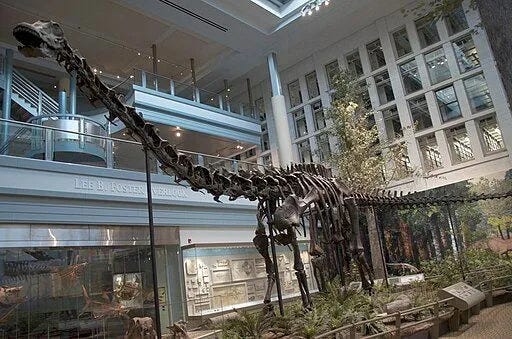
Figure 1
My bad. Actually, this is the Diplodocus.
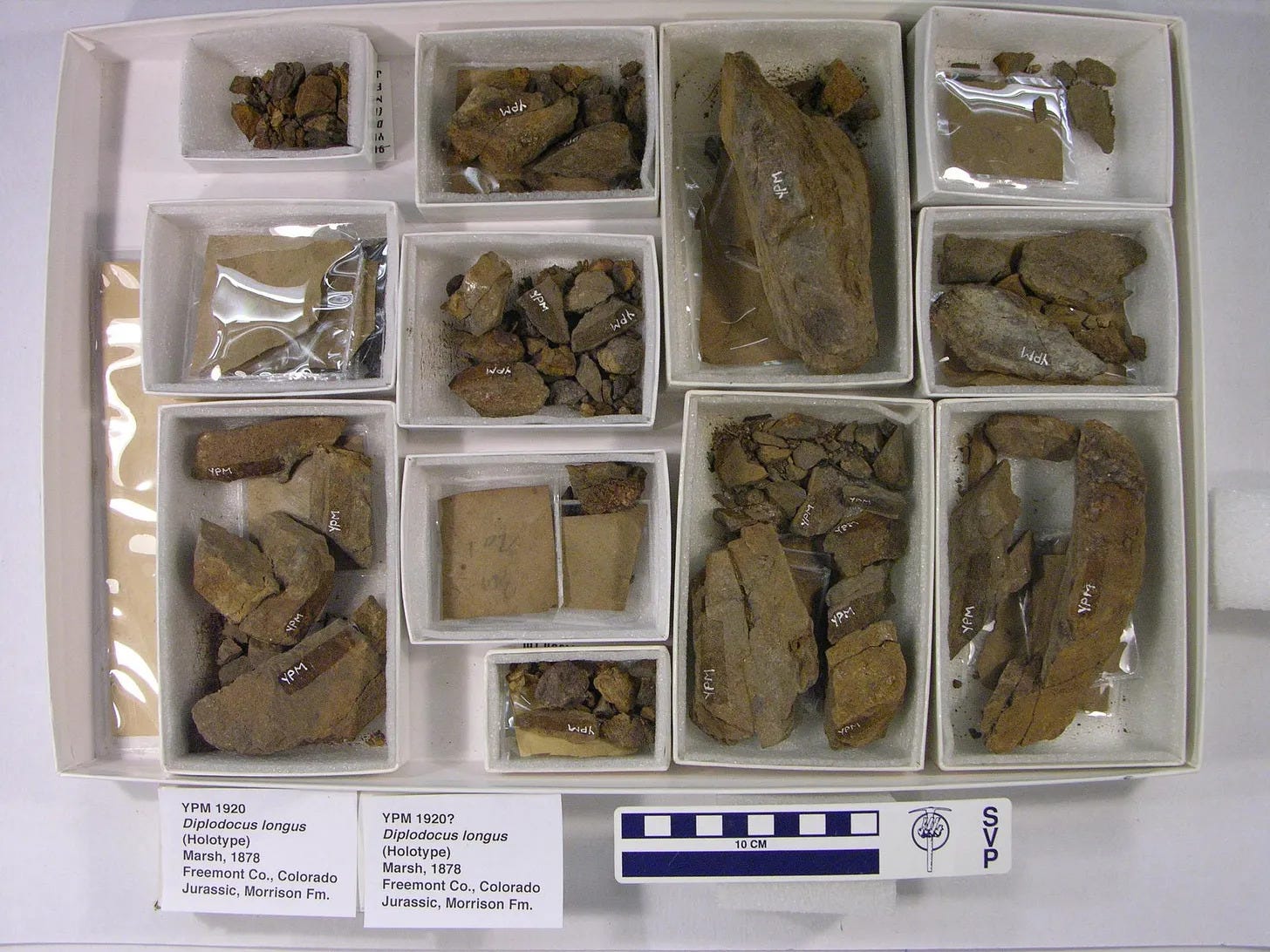
Figure 2
That’s what actually came out of the ground. How about the Big Daddy, T-rex?
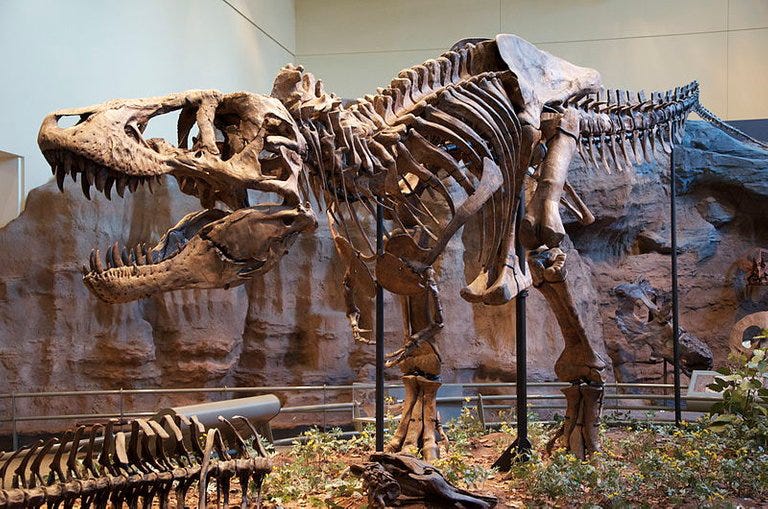
Figure 3
Here he is, being unearthed.
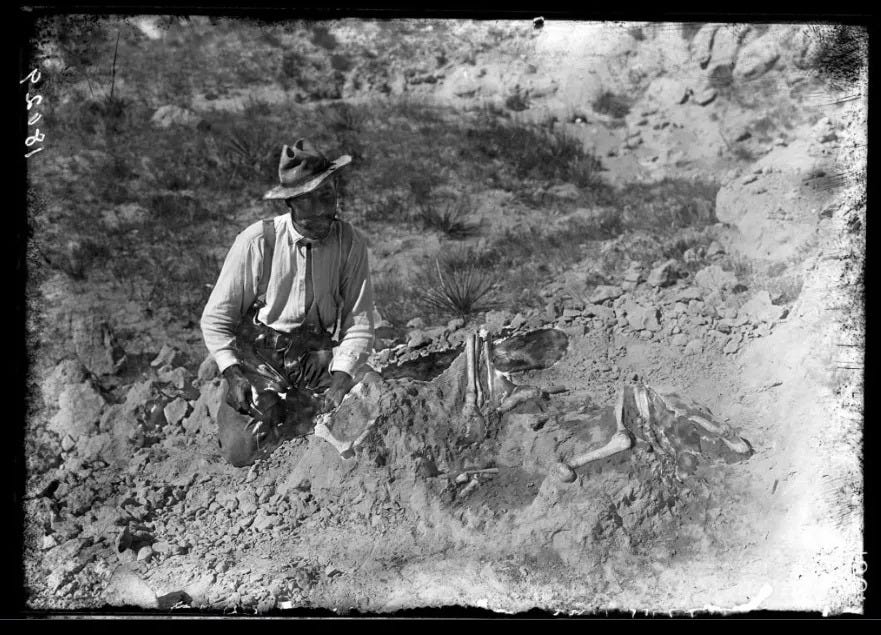
Figure 4
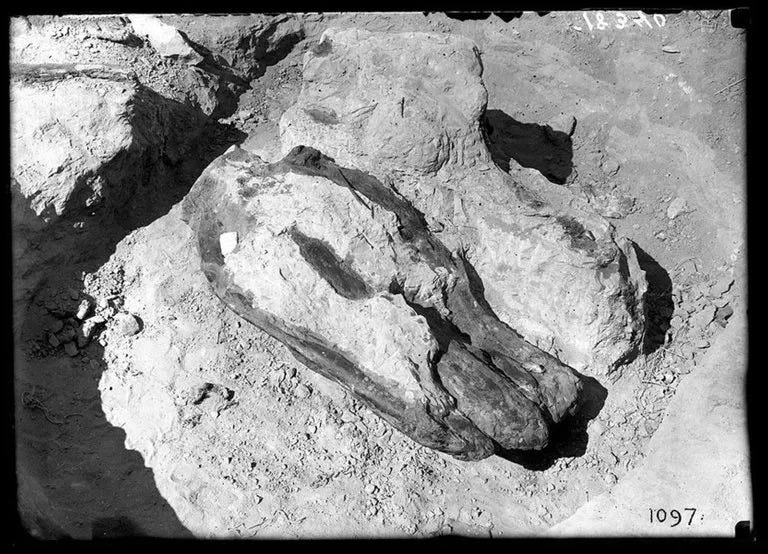
Figure 5
Sleight of hand is par for the course. The most frequent methodology seems to follow this path. First, a collection of bones (rocks, fossils) is found, frequently across different days and/or locations. In the following instance, our friend Cope decided that they all went together.
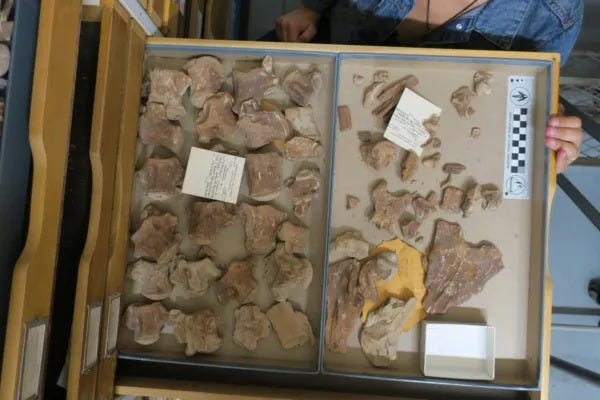
Figure 6
A large helping of full-fat creative license then produced this.
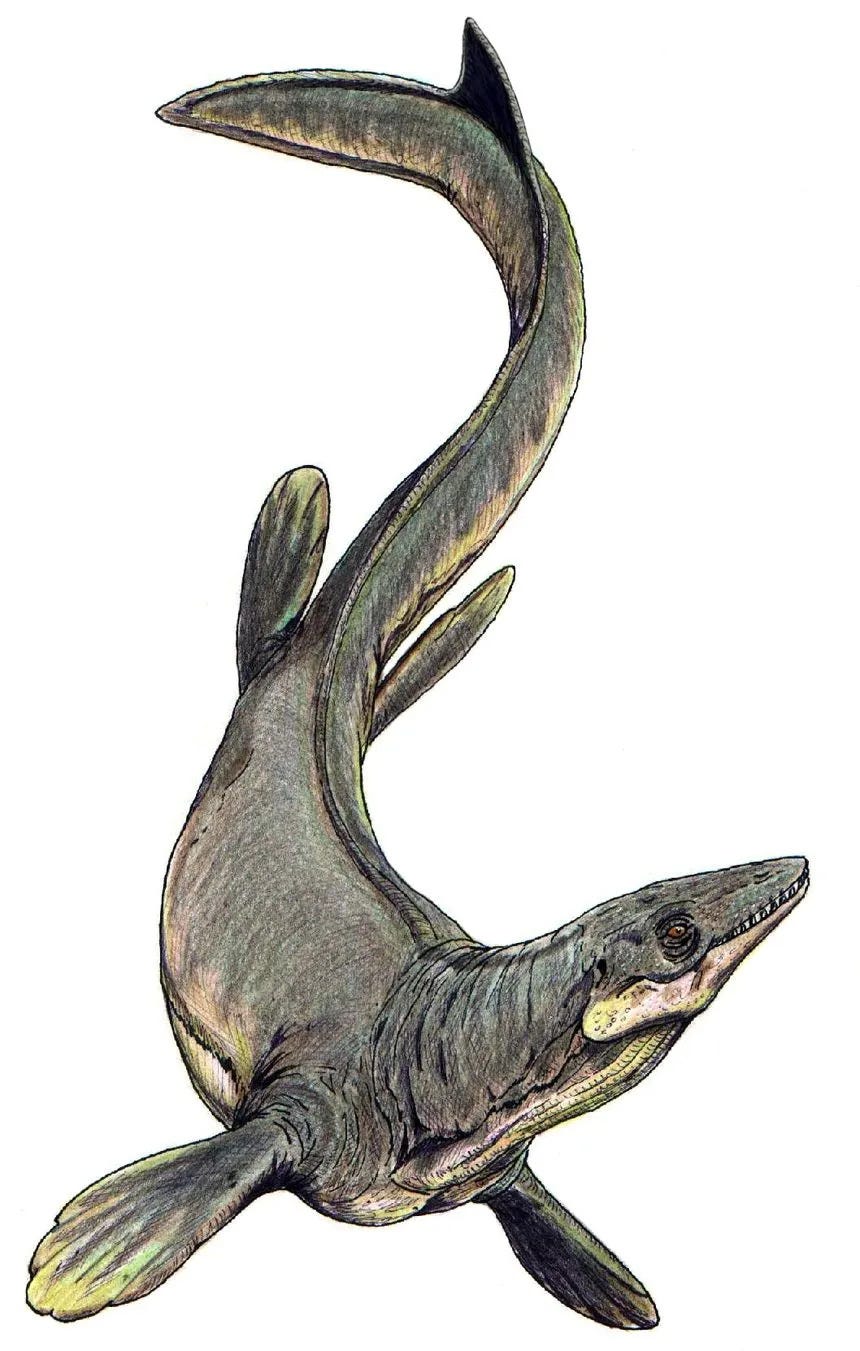
Figure 7
And what ends up in the museum is this.
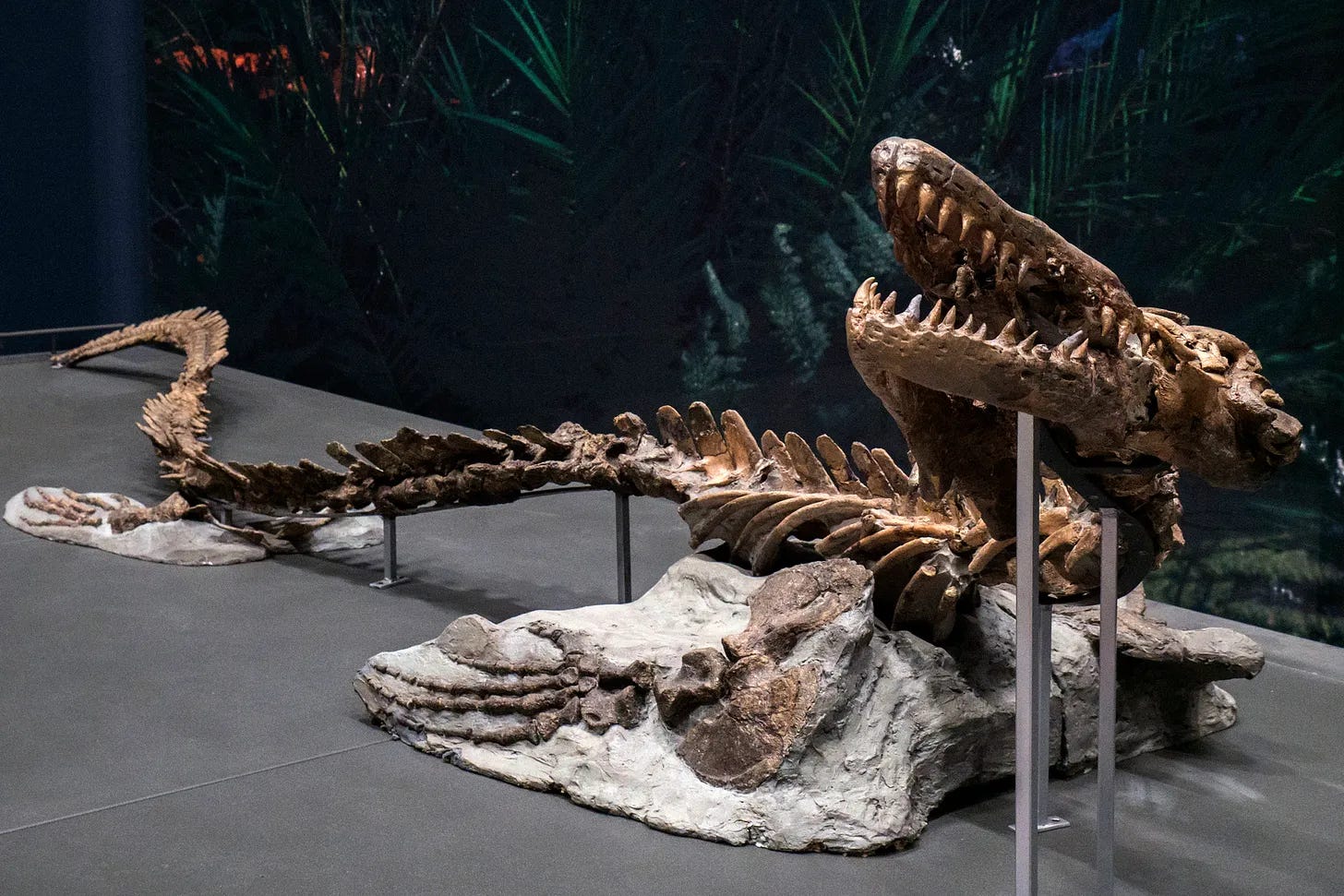
Figure 8
That was the Platecarpus tympaniticus. This is the Carnosaur, minus three tiny pieces.
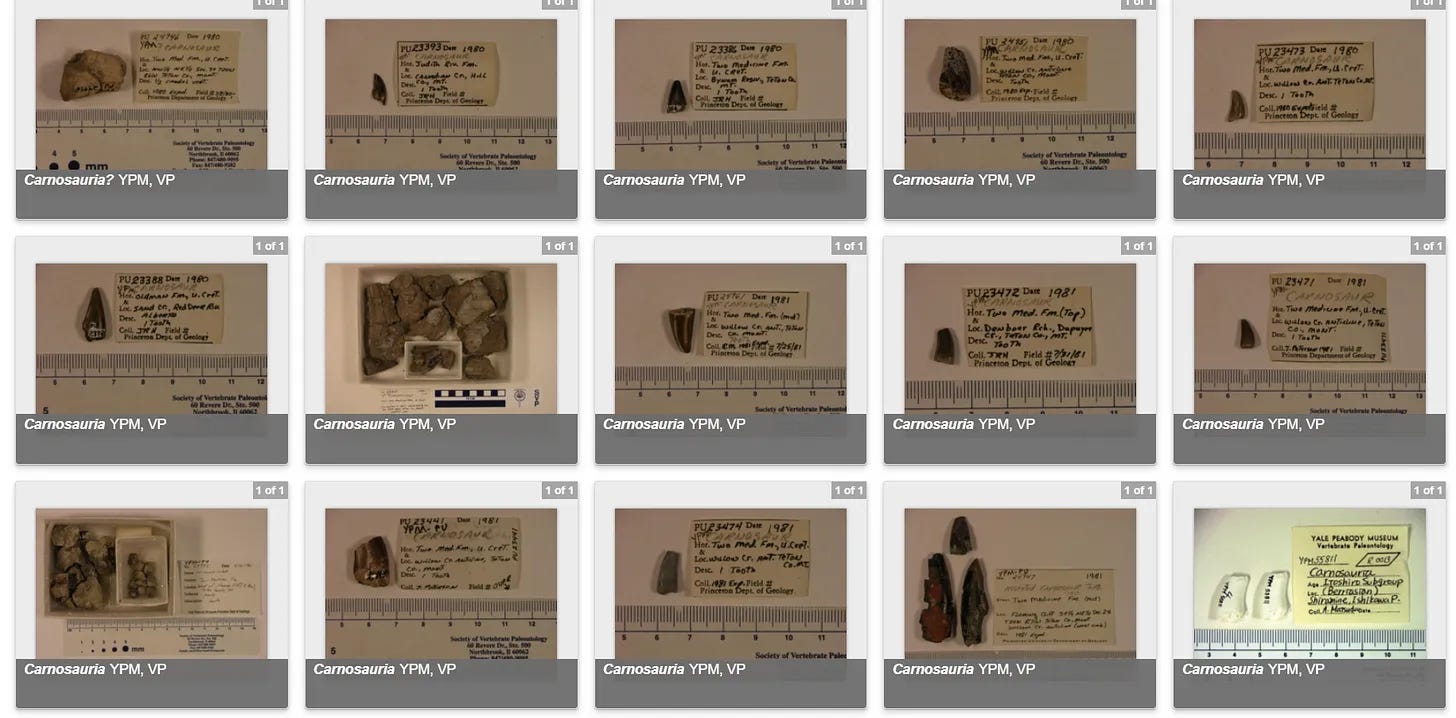
Figure 9
Which, when extrapolated, looks like this.
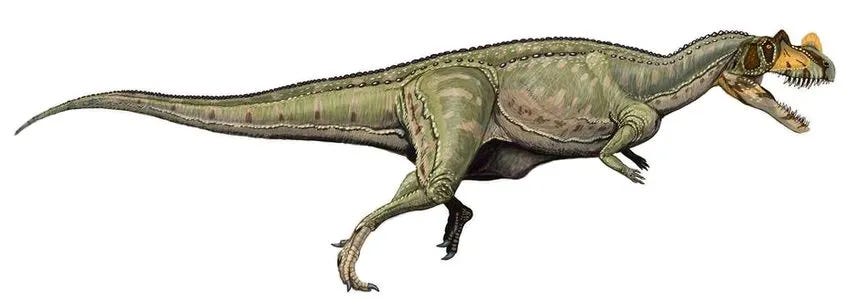
Figure 10
Thus, our friendly neighbourhood museum displays this skeleton.
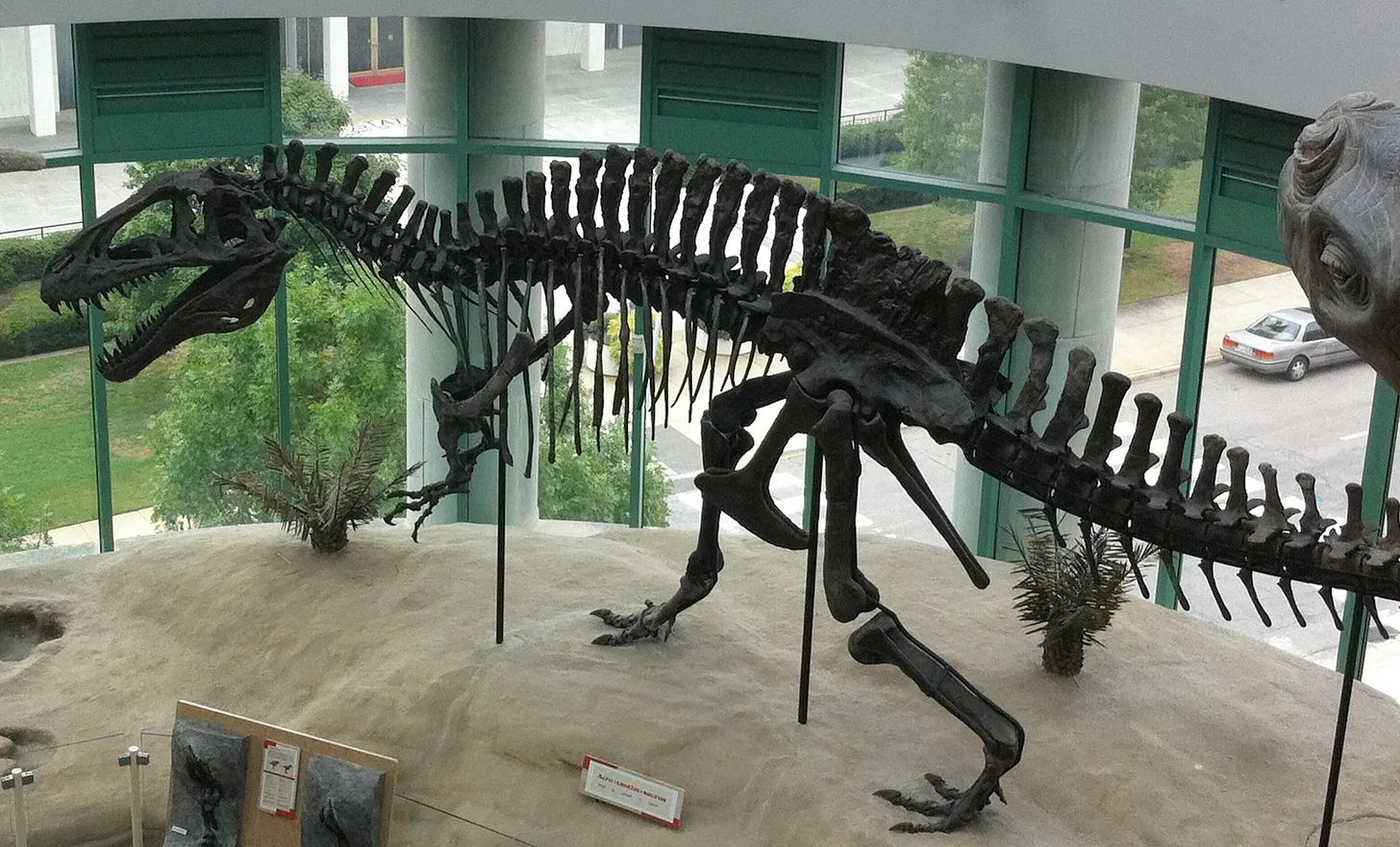
Figure 11
This is how the game is played, across the board and, although I’m not a scientist, I’m going to go out on a limb and cry foul. You will have gathered that the ‘bones’ in these alleged replicas are not actually real bones. Those are completely off-limits, even to professionals. Something to do with them being radioactive, super-heavy, fake – perm any one from three. There’s an entire cottage industry out there, dedicated to perpetuating the fiction, wittingly or otherwise. It seems that every single species is a fabrication. All are the figments of various imaginations and all are providing sterling service to the evolutionists.
Figure 12
That’s just a whistle-top tour; if you need more, click on the citations. But, nothing with the slightest resemblance to a Stegosaurus or a Triceratops has ever been found. No complete skeletons (not even close), much of what palaeontologists claim to have found are now rocks, not the original bones - a process that neither you nor I will ever get to witness – the representations of the ‘dinosaurs’ are egregious works of fiction, and those sold at auction are cobbled together according to the sketches and in-filled with ‘real bone material’, which the layperson would correctly identify as the bones of chickens, horses, dogs and so forth. Go large or go home.
Speaking of which, American ‘dinosaurs’ are considerably bigger and more imposing than their European colleagues (you betcha), a circumstance ascribed to location, location, location by establishment stenographers, who have a handle on conditions allegedly millions of years in the past:
“But the United States also proved an exceptionally receptive environment for these creatures, a fertile niche that promoted their development into the towering behemoths that continue to wow museum visitors.”(57)
There are what we may charitably describe as ‘issues’ with the dating methodology, also. Dakota, a 1999 discovery, is supposedly 100 million years ago, but still has muscle and skin.(58) NASA found it, via satellite or something.(59) Researchers have also found proteins and DNA in what they claim to be dinosaur remains.(60) You’d have to be some sort of tinfoil-hatted denier to throw shade at that, even though it is known that the decay rate of DNA precludes the possibility that it could last hundreds of thousands of years, let alone millions.(61) But, no matter. What’s one more false note in a symphony of them?
Sadly, there are plenty of reasons to doubt the entire chronology of the dinosaurs. And of earth itself. The dating methodology, if we can call it that, relies upon certain assumptions, rather than on a solid bedrock of ‘science’. Gradualism is one such, theoretical age models another. The underlying conviction is that earth is millions of years old – all conclusions are formed with these factors embedded in the calculations. So, once again, one cannot call the results scientific. No open-minded spirit of enquiry is in play. And nobody wants to acknowledge the fact that what they are engaged in is partisan guesswork conducted within a rigged framework, nothing more.
But what about carbon dating? And the aforementioned ice cores? What about rock strata? And our evolutionary forebears? Well, ‘carbon dating’ – a calculation based on the rate of decay of Carbon-14 within once-living things – is only truly effective out to about 3,000 to 4,000 years and, even then, only if it can be corroborated historically. Nearly all C-14 would be gone in less than 60,000 years,(62) yet ‘dinosaur bones’ routinely test positive for C-14,(63) which would suggest one of two things; either the bones don’t belong to dinosaurs from 65 million years ago, or T-rex walked amongst us pretty recently – certainly, since man has been around, according to the evolutionary timeline.
So, if carbon dating cannot be used to date the earth, what can be? Well, mostly the fossil record and the rock strata, organised into a geologic column based on gradualism and a complete absence of catastrophes. Something like this.
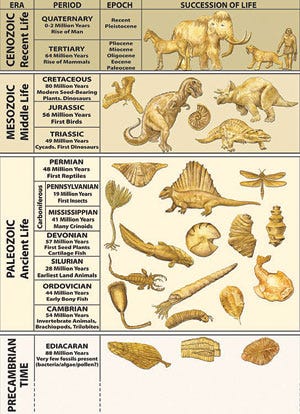
Figure 13
“Most of Earth’s land surface is covered with sedimentary rocks or sediments, which are formed when pre-existing rock material is weathered.... Within these water-deposited sedimentary rocks are the fossilized remains of billions of plants and animals.”(64)
It should be noted that 95% of fossils are marine creatures and less than 1% are land animals. This makes sense, as the latter have “low-fossilization potential,”(65) due to the fact “that fossilization requires rapid burial. Ordinarily a dead animal is consumed by scavengers or it decays into oblivion.”(66) In the ordinary way of things – according to the gradualists – land fossils ought to be exceedingly rare and there is no obvious reason why marine and land animals should be buried together, yet that is frequently the case.(67)
The rock itself is said to have been laid down gradually, over many millions of years, under water. Some of the less dogmatic evolutionists are prepared to accept that – perhaps – there is evidence of rapid deposition via catastrophic processes, but they still insist that aeons separated those episodes and that each layer hardened before the next deposit. This theory is testable, to a degree, as tectonic plate movement would fracture the strata, rather than bend them. In addition, evidence of animal burrows and plant root systems ought to be present, as they are on modern soil surfaces. Those have the potential to destroy the soft sedimentary structure, given time. The question is, how much time?
“A recent study undertook to determine just how much time was required to destroy all remnants of water action...it was observed that within months, all sedimentary structure was destroyed, so intense is the bioturbation in soft sediments. As long as the sediments are still soft, they will be bioturbated and the structure lost.”(68)(69)
In other words, it oughtn’t look a whole lot like this.

Figure 14
Nor like this.
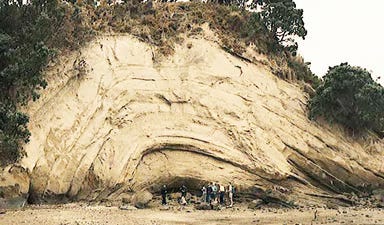
Figure 15
Nor this.
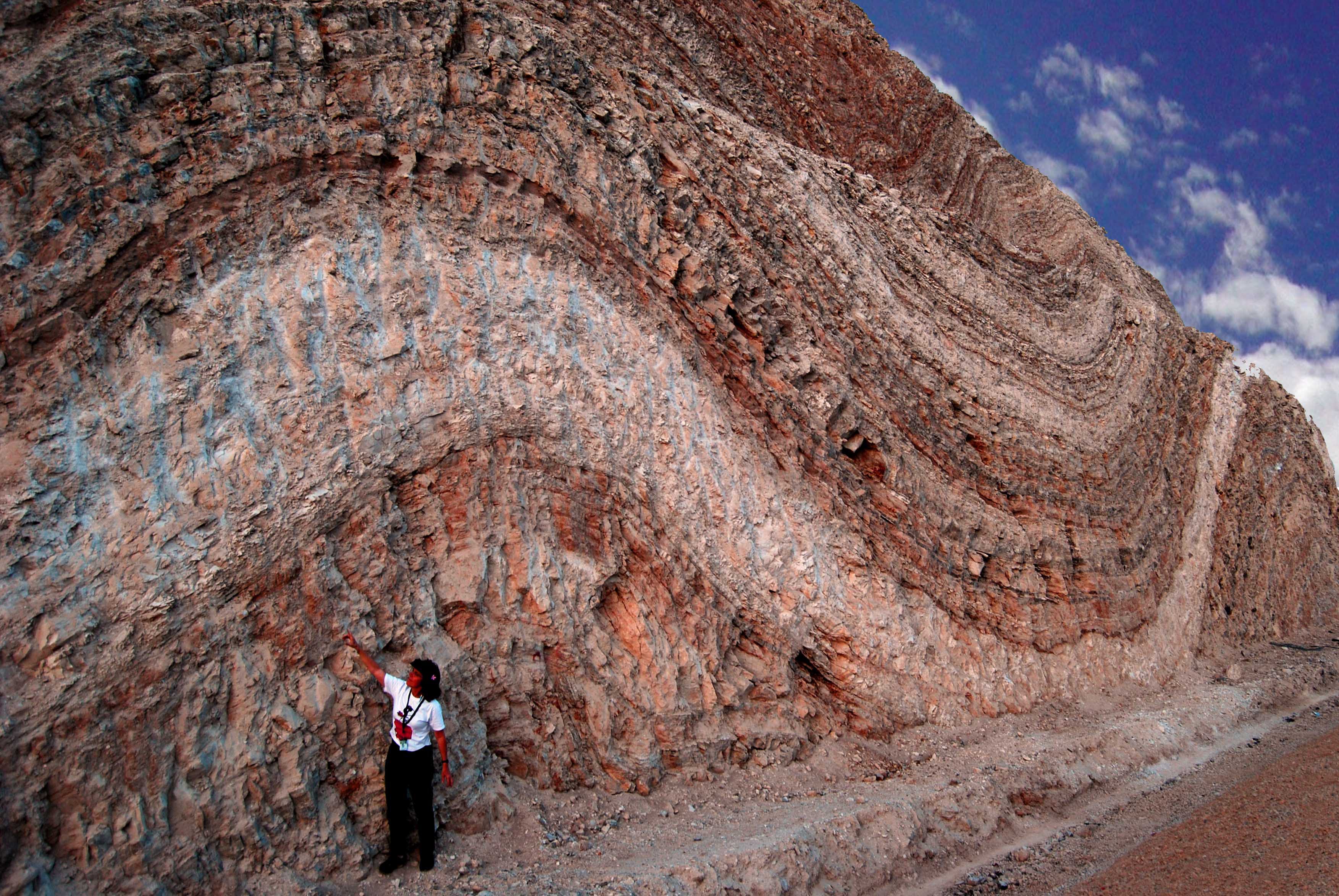
Figure 16
Radical folding such as in Figures 15 and 16 takes place when sediments are soft and pliable, and can be seen worldwide. Many of these formations contain animal track-ways but are almost devoid of plants, which would not be the case were they to be ecosystems of an entire era, as claimed.(70) Rapid formation of sediments, rather than a gradual accumulation as per the narrative, can be accomplished in vastly shorter time-frames. This is not guesswork – the St. Helens volcanic eruption in 1980 provided us with a geologic lesson in real time.
The main eruption filled a valley with hundreds of feet of sediment and was followed with another shortly thereafter and one more in 1982.
“Mount St. Helens revealed to the world that both thick and thin layering can happen fast...sedimentary layers hundreds of feet thick formed within hours during the eruption itself, and then hardened into rock soon after the water drained from them.”(71)
Even without the benefit of catastrophe, sedimentary rock can form in less than thirty-five years, as along Scotland’s west coast.(72) The St. Helens site also gave the lie to radioisotope dating. Rock that was ten years old was dated in a range of between 340,000 to 2,800,000 years,(73) which was not simply incorrect, but also remarkably imprecise.
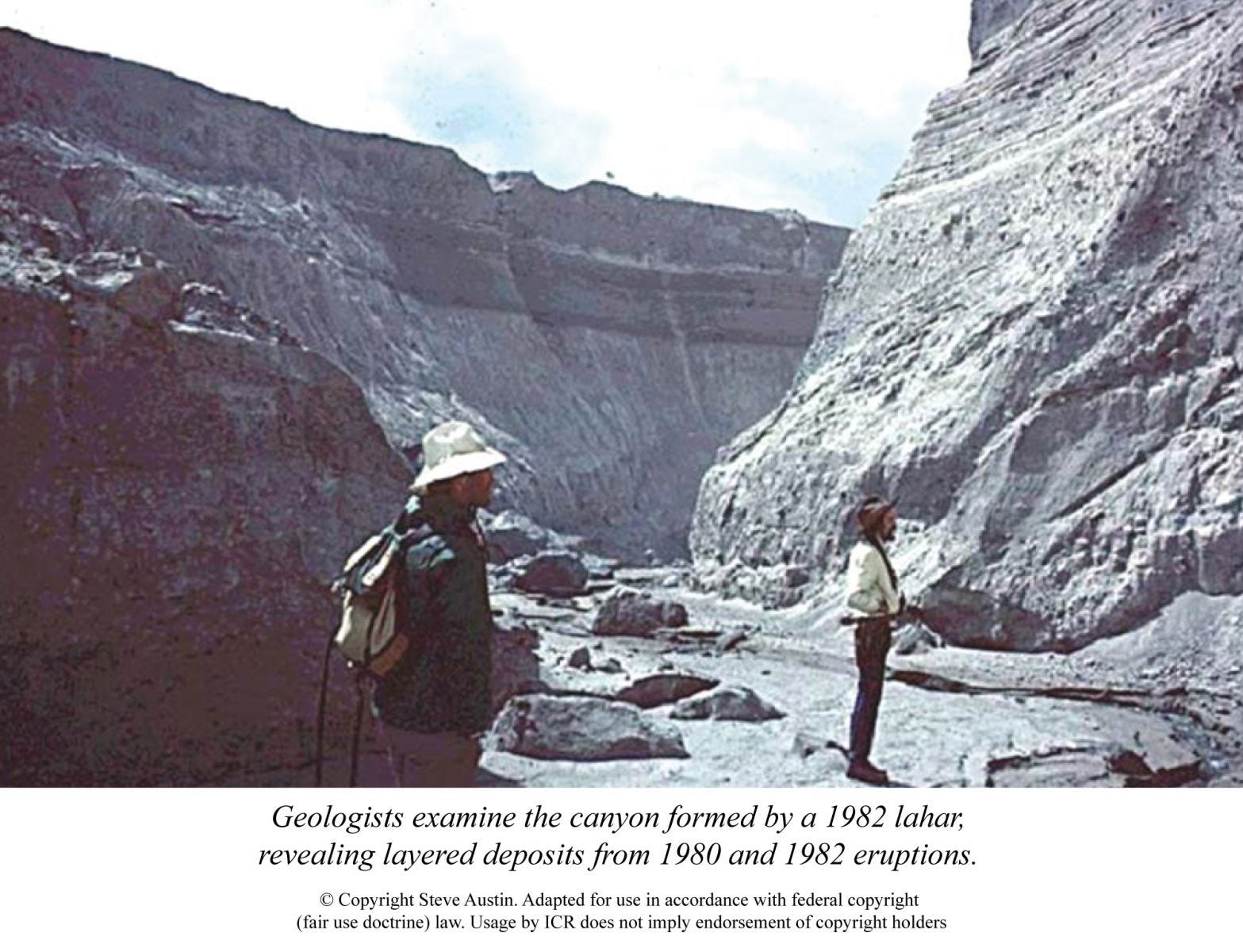
Figure 17
Then there is the seeming conundrum of what the supposed experts refer to as ‘polystrate fossils’, which straddle the sedimentary strata. Were dogma to be abandoned and proper scientific analysis adopted instead, the obvious conclusions could be drawn. Polystrate fossil logs are common, running vertically through several layers – a sensible person might be tempted to ask the obvious question:
“How did they stand there for millions of years while the layers of deposits built around them, and all without rotting away?”(74)
They obviously didn’t. But they also show up in coal which, contrary to yet another myth pulled from the evolutionists’ grab bag, forms quickly – weeks for brown coal, months for black coal.(75) Oil and natural gas aren’t formed quite as promptly but, in the lab, four years was all that was required to mimic nature.(76) And less than perfect natural conditions off California were all that were necessary to form oil and gas in well under 5,000 years.(77) All of which goes to show that, even without catastrophic interventions, stuff can happen awful quickly and clearly has in the past.
Then there are the La Brea Tar Pits, near downtown Los Angeles, from which over three and a half million specimens (from 600 species) have been extracted.(78) These, in marked contrast to the dino scam, are genuine skeletons, albeit composites. And some of them are big. Way bigger than today’s counterparts.
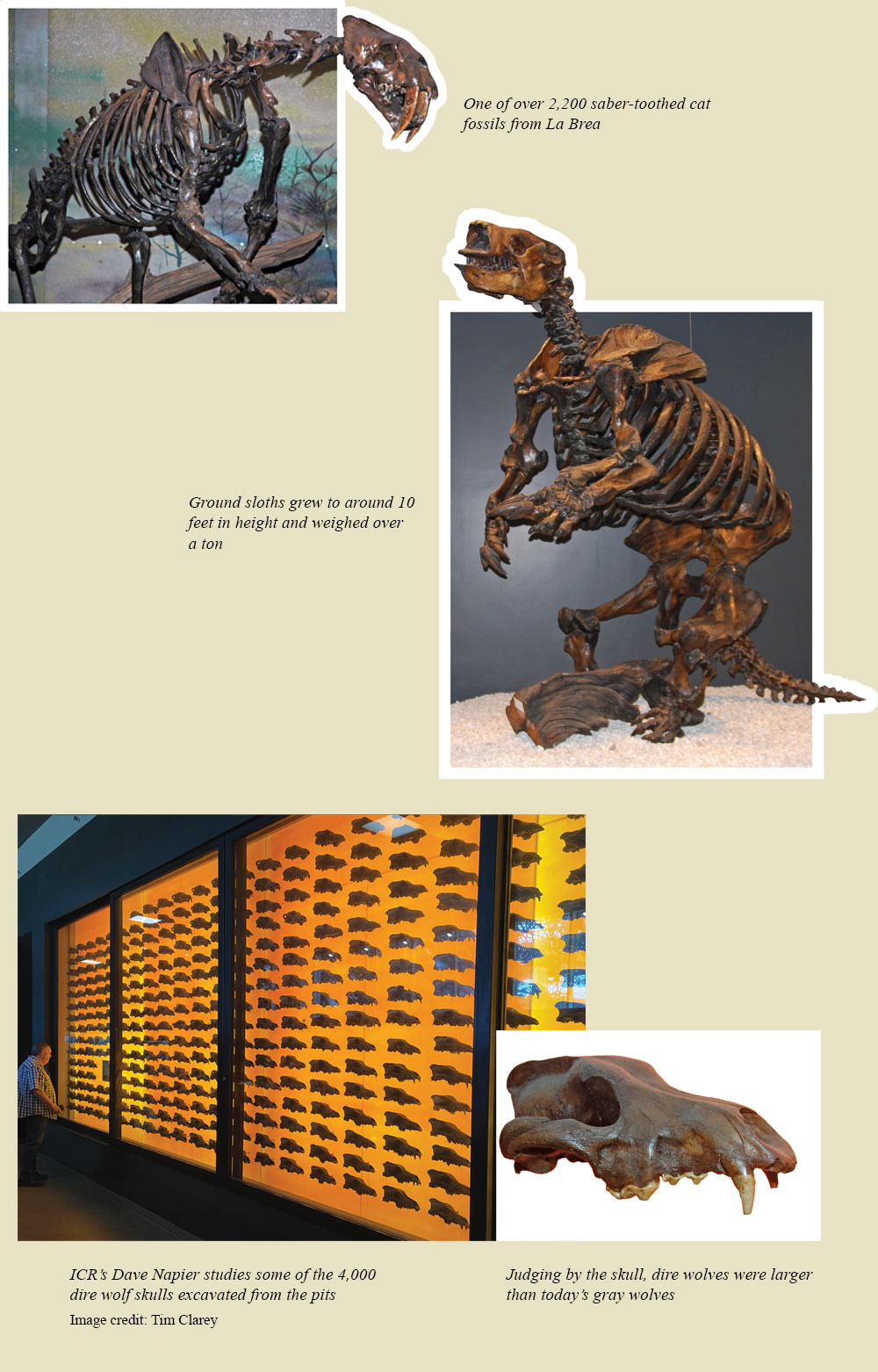
Figure 18
“...the plants and animals of the ancient past are consistently larger and more vigorous than their modern counterparts. The record is clear: degeneration, not regeneration, is the name of the game in the history of living organisms...”(79)
It is also widely accepted that the fossils are indicative of a flood deposit (they are jammed-together victims, and crushed bone fragments predominate), a phenomenon that would be consistent with the rock strata evidence. There are other graveyards, such as the Cumberland Bone Cave fossils from Maryland, which are also water-laid deposits.(80) Not to mention the enormous quantities of mammoth bones preserved in the Arctic permafrost which, as previously noted, would not exist were it not for “rapid changes in climate and catastrophic burials.”(81) Scavengers would have done what scavengers do, otherwise. Nonetheless, as it stands;
“...when fossils are found they are dated according to the theory that the bottom layer is 900M+ years old and the top layer is 10M+ years old.”(82)
Which brings me to the ice-core data and then to humanity itself. We immediately encounter the two hardy perennials – gradualism and modelling – once again. The Milankovitch ice age theory is the go-to hypothesis, and it holds that it’s the Earth’s rotational and orbital motions that influence the world’s climate and explain the various ice ages.(83) However, its proponents harbour a guilty secret:
“Uniformitarian scientists claim that chemical clues within the seafloor sediments tell a “story” of climate change over millions of years and that this “story” agrees well with expectations of the astronomical (or Milankovitch) theory of Pleistocene ice ages. Yet secular scientists routinely use the astronomical theory to date the seafloor sediments on a technique called “orbital tuning”.(84)
In other words, a bright, perfectly-formed specimen of circular reasoning, which the savvier establishment types recognise. The claim that ‘independent’ checks salvage the narrative unravels when all of them assume that the evolutionary paradigm is true; further, the different dating systems used suffer from the same original fault, as they are all calibrated with each other.(85) So, once again, the overwhelming urge to reinforce the approved version of events leads to gaslighting and dishonesty, which oughtn’t be necessary if the case was solid.
The ice cores themselves are dated by using theoretical ice-flow models, for the most part. These models assume that the ice sheets are millions of years old (Milankovitch, again),(86) so the vast ages that are assigned are a given. Another familiar fallacy also gets warmed over – the insistence that specific evidence is capable of only one interpretation. In this case, scientists aver that they can accurately date Antarctic ice cores by correctly identifying annual layers, despite the fact that dozens of distinct layers can be laid within a few years, “with the number of layers varying from year to year.”(87)(88) So, they (scientists) can’t, especially at greater depths. They also attempt to count seasonal dust peaks, even though they acknowledge that ancient storms could have deposited any number of non-annual peaks.
The Greenland ice sheet is a more reliable source of evidence, due primarily to the larger precipitation rates, which are well-preserved. The sheet is around 4,000 feet thick and, over the past fifty years, has been accumulating at an annual rate of five feet. We know this because, in 1942, eight US Navy aircraft made an emergency landing and, whilst the pilots were rescued, the planes were left in situ. They were only found again, in 1988, with the help of ground penetrating radar as they were buried under 250 feet of ice.(89)
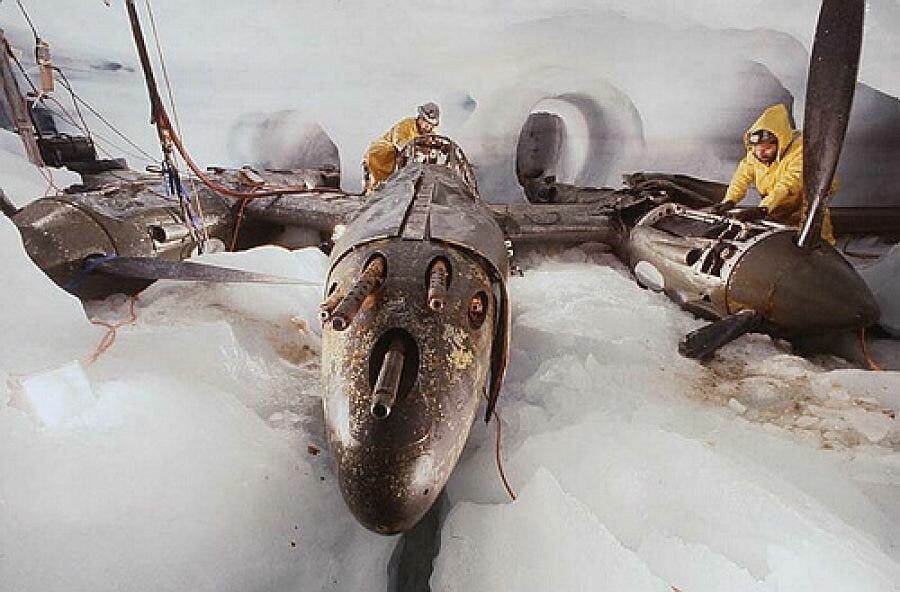
Figure 19
Tempting though it is to utilise simpleton’s maths – a variation on the gradualist formula – to conclude that it would then take less than 1,000 years for the ice sheet to form, other considerations much be factored in, such as compaction, thinning and other measurements from across the ice cap. Nonetheless, an age of less than 6,000 years is possible if “we assume the average annual thickness to be the mean between the annual thickness at the top and at the bottom (about eight inches)”,(90) a method the evolutionist would favour. Intra-seasonal oscillation of ð18O – measuring annual precipitation – is in good agreement with this hypothesis, although lower in the ice sheet there is less certainty.(91) Similar calculations in Antarctica are complicated by the slow accumulation of ice:
“By the time the ice has been buried deeply enough to no longer be influenced by the atmosphere, annual variations have been greatly dampened by diffusion.”(92)(93)
It is apparent, then, that absent a pre-determined, non-validated framework, the ice core evidence is not definitive, although we are informed that it is. Gradualism cannot be assumed and, at best, even glaciologists admit that the uncertainties probability limit the number of countable layers to around 8,500 in Greenland, with the possibility that numerous layers were laid each year.(94) So much for ice cores.
Finally, in this telling, we come to humanity. What can we bring to the party? Given the absence of evolutionary evidence and the entire concept’s violation of accepted natural laws we shouldn’t, perhaps, expect much. If other animals haven’t evolved, why would we? Darwin’s theory applies equally to all animals and that’s all that humans were to him – just another animal. Still, the scientists seem to have a working hypothesis on the front-burner – something approximating this.
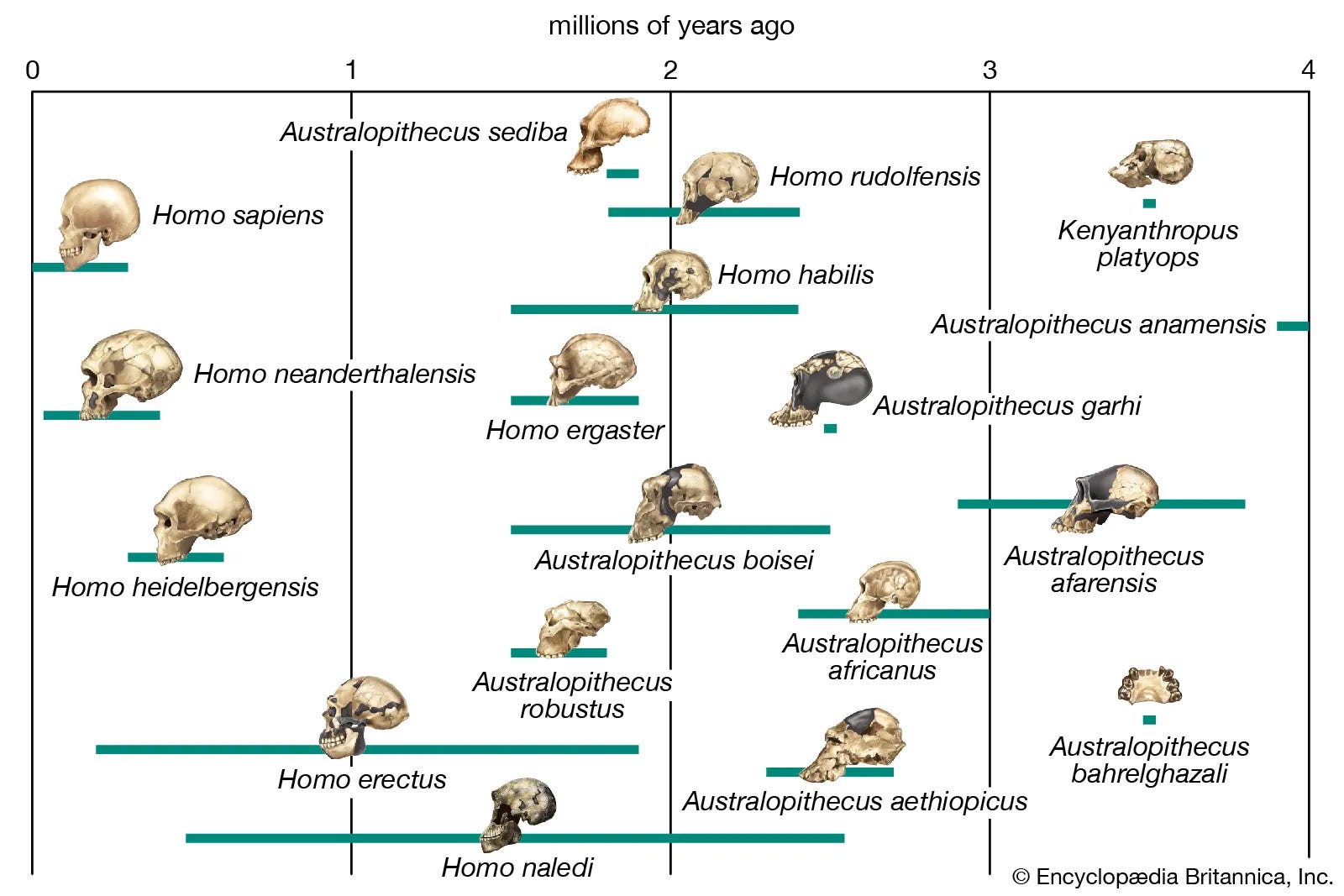
Figure 20
Sure, it gets updated every now and again as some new discovery upsets the apple-cart, but the basics are ‘settled’, aren’t they? What with all that evidence.
“All that paleoanthropologists have to show for more than 100 years of digging are remains from fewer than 2000 of our ancestors. They have used this assortment of jawbones, teeth and fossilized scraps, together with molecular evidence from living species, to piece together a line of human descent going back 5 to 8 million years to the time when humans and chimpanzees diverged from a common ancestor.”(95)
It turns out that the fossils that allegedly form our family tree are remarkably scarce. All the ‘evidence’ for human evolution “can still be placed, with room to spare, inside a single coffin.”(96) To my knowledge, that is not a fact that is widely publicised. Nor is any thought given to a necessary corollary to the evolutionists’ tale – if humans have been around for two to three million years, many trillions must have lived and died. So, where are their fossils? We can find ‘dinosaur’ bones that are alleged to be 65 million years old, but not human remains from considerably more recent times? I assume that, at some point, our ancestors would have started burying their dead, rather than abandoning them to the wildlife, which would surely increase the odds of discovery. But, no.
Yet the bones that have been found seem to disproportionately represent ‘missing links’ (until they are inevitably debunked): Piltdown Man, Nebraska Man, the Neanderthals, Lucy, Ida, et al.(97) Lucy was simply an ape.(98) And, yes - I included the Neanderthals, a source of pride to the evolutionists - whose DNA was at least 99.7% like that of ‘humans’, with whom they mated and lived alongside.(99)(100)(101) Ordinarily, of course, creatures (especially humans) mate only with their own species.
The idea that Neanderthals are transitional creatures, somewhere between ape and man, “is being shown to be a mental construct that took on a life of its own.”(102) Today’s reconstructions of them look just like us – some of them were even gingers with freckles.(103) Other evolutionist articles of faith are also incoherent, even by their own methodologies, as “anatomically modern Homo sapiens, Neandertal, archaic Homo sapiens, and Homo erectus...all lived as contemporaries.”(104)
Or, to put it another way, were all indistinguishable from modern man. Quite how an evolutionary fable can be constructed from a single coffin of fossils is unknown to me, particularly in the absence of evidence for any other creatures’ ‘transition’. Whilst the contention is that Homo erectus evolved around 1.5 million years ago, transitioning to Homo sapiens about 1.1 million years later, leading anthropologists aren’t buying it.(105) The differences are so small that the two appear to be one and the same. There are other problems:
“Fossils classified as H. erectus all share a set of “primitive” traits including a sloping forehead and large brow ridges, yet these all fall comfortably within the range of what are called normal humans today. For example, the very same traits are found in some modern people groups, including Eskimos.”(106)
In addition, in a cave in Georgia, scientists found what they believe to be five human skulls or partial human skulls. All had very different shapes, yet all were buried together, within a short time span. Instead of transitional human forms, the fossils demonstrated that variation was occurring at the same time.(107) And, once again, the dating methodology stinks. There is no way of precisely calculating the age of these fossil remains via carbon-dating, as previously noted.
So, evidence that doesn’t comport with evolutionary theory is ignored and the approved bandwagon continues on its way. Most people are still under the impression that our DNA is 98.5% similar to that of the chimpanzee, but this is not the case. At most, it’s 85% similar (84.38%, to be precise) – the scientists responsible for the falsehood gerrymandered the data to get it to match their dogmatic presupposition that humans evolved from apes.(108) Presumably, the reason why such a finding is memory-holed is that it punctures the common ancestor fable below the waterline – a 15% divergence in DNA in 3-6 million years is no longer feasible.
If the evolutionary cult was in genuine pursuit of answers, a study of the human genome could still have utility. Mitochondrial DNA (mtDNA) and nuclear DNA analysis had provided succour for the Recent African Origins (RAO) theory – once “ a whole host of...questionable genetic assumptions” of an evolutionary flavour had been added to the mix -(109) whereby humans evolved in Africa between 100,000 and 200,000 years ago. But archaic DNA studies, conducted by establishment types, have thrown a succession of wrenches in the evolutionary machine, pushing the timelines back to 600,000 years.
The infamous molecular genetic clock – yet another tool wholly corrupted by assumptions that aren’t empirically based – is one of the evolutionists’ favourite toys. Once it’s loaded up with macroevolutionary dreck, it is used to ‘prove’ deep-time divergence of species. But the mtDNA mutation rates, first analysed in 1997, have caused a major headache. True believers noticed the problem early-doors and spent years trying to make the evidence fit their assumptions but, once the evolutionary suppositions were stripped away, the age of the MRCA (the most recent common ancestor) wasn’t even close to millions of years in the past:
“In 2012 and 2013, two major secular papers were published that each analyzed the rare mutational variants in human protein coding exons among ~9,000 individuals of various ethnicities and found that, based on demographic models, as opposed to standard evolution-calibrated models, the rare mutational variation in the human genome could be no older than 5,000 to 10,000 years.”(110)(111)
Further research narrowed it down to around 6,000 years of maternal human lineage.(112)(113) A study of the Y-chromosome revealed that, although mutation rates varied over time, both the paternal and maternal genomes were less than 10,000 years old.(114) Because the Y-chromosome is a loner, it has no counterpart with which to exchange genetic information. This makes it a good study when calculating a genetic clock. A 2019 study is particularly potent:
“In this study, they noted that if humans have actually been around for several hundred thousand years or more, according to RAO they should have accumulated 8 to 59 times the amount of mutations that we currently observe in Y chromosomes worldwide.”(115)
Curious, isn’t it? The studies are by what we might call ‘creationists’ and secular scientists alike. That being the case, it would be imprudent to dismiss them as a Bible-basher’s fever dream, I would suggest. Especially as a secular study of language, genetics and demographics found that migration patterns did not match the RAO schema, nor do they support a single line of descent out of Africa.(116) The evolutionists are increasingly driven to straw man arguments and more circular reasoning, such as this beauty from atheist extraordinaire, Richard Dawkins:
“Evolution has been observed. It’s just that it hasn’t been observed while it’s happening.”(117)
Which is just another way of saying ‘trust the experts’, not something that a good chunk of the population is any longer prepared to do. I suspect that the hard-core of the evolutionary movement will never accept any evidence that contradicts their beliefs, because “the fact is that evolutionists believe in evolution because they want to.”(118) They have swallowed the theory whole, presumably because it meshes with their view of humanity. They haven’t worked through what evidence there is and formed conclusions; they’ve treated what was a hypothesis (which was already disintegrating during Darwin’s lifetime, as he himself was aware) as fact.
Once they had convinced themselves of the randomness of the Universe, they then set about defending the indefensible. Neither mutation theory nor natural selection can stand up to any scrutiny, as both violate scientific laws which dictate that systems don’t improve – instead, they decline over time. But once certain assumptions are plumbed into their model, the way in which they measure the age of the world can be calibrated and the self-affirming cycle can begin. Dating techniques are not empirical – they are the product of magical thinking.
The entire fossil record, the geologic record and humanity’s history are all grist to the mill. Add a soupçon of what looks like outright fantasy – Stegosaurus and co. - whisk, and admire the handiwork. And, although you and I may be most reluctant to accept that we have fallen for a fiction of this magnitude, we should remember that Darwinism has been with us for less than a hundred and seventy years; prior to that, in the West at least, versions of the Creation story had always been considered objectively valid, whether as allegory or as the gospel truth. The evolutionists’ motivation has never been about ‘following the science’, but something else entirely:
“It is their desire at all costs to explain the origin of everything without a Creator. Evolutionism is thus intrinsically an atheistic religion...Whether atheism or humanism (or even pantheism), the purpose is to eliminate a personal God from any active role in the origin of the universe and all its components, including man.”(119)
As is my wont, I have written this piece over multiple days and it’s only when I proofread that I reacquaint myself with its flow. The treatment feels a little superficial, given the subject matter, but providing answers is not my intention. Rather, it’s to demonstrate – in short form - that the narratives that cannot be relied upon span the entire spectrum and include humanity’s origin story. As I hope I’ve demonstrated, the evidence for the theory of evolution just isn’t there. It’s my intention to examine that other legend, the Big Bang Theory, in Part Two.
Citations
(1) https://press.rebus.community/historyoftech/chapter/evolution-before-darwin/
(2) https://christiancourier.com/articles/are-science-and-faith-compatible
(3) Lewontin, R., Billions and billions of demons, The New York Review, January 9, 1997, p. 31.
(4) Ditto
(5) https://christiancourier.com/articles/evaluating-evolution-in-plain-english
(6) Jastrow, R., Until the Sun Dies, W. W. Norton & Co., New York, 1977, p. 62-63.
(7) Conklin, Edwin. 1963. Reader’s Digest. January p. 92.
(8) https://creation.com/en/articles/is-evolution-true
(9) Darwin, F., The Life and Letters of Charles Darwin, Volume 3, FB&C Limited, 2017, p. 26.
(10)https://www.stempublishing.com/authors/pollock/Evolution_Unscientific_and_Unscriptural.html
(11) https://creation.com/en/articles/evolution-ancient-pagan-idea
(12) https://www.equip.org/articles/is-darwinism-atheistic/
(13) Tahmisian, Theodore N., Fresno Bee, August 20th, 1959.
(14) https://creation.com/en/articles/atheism-needs-evolution#forwardref-3
(15) Lamont, A., Creation 15(3): 45-47, 1993.
(16) Woodmorappe, J., Creation 13(1): 14, 1999.
(17) Bowlby, J., Charles Darwin: A new life, W. W. Norton & Co., New York, 1990, p. 344.
(18) https://www.equip.org/articles/is-darwinism-atheistic/
(19-20) Ditto
(21) George Grinnell, “The Rise and Fall of Darwin’s First Theory of Transmutation,” Journal of the History of Biology 7, 2 (Fall 1974): p. 273.
(22) https://creation.com/en/articles/its-not-science#reference-87d12e63-ee76-54da-8e2c-b104a24aaaa9
(23) https://knowingscripture.com/articles/why-do-human-lifespans-not-reach-120-years-genesis-63
(24) Evolution in Action as quoted by Marshall and Sandra Hall in The Truth: God or Evolution?, Grand Rapids: Baker, 1974, p. 23.
(25) https://christiancourier.com/articles/evaluating-evolution-in-plain-english
(26) Hall, Marshall and Sandra, The Truth: God or Evolution?, Grand Rapids: Baker, 1974, p. 142.
(27) Sunderland, Luther. Darwin’s Enigma. El Cajon, CA: Master Books, p. 106.
(28)https://www.icr.org/home/resources/resources_tracts_scientificcaseagainstevolution/
(29) E. H. Lieb and Jakob Yngvason, “A Fresh Look at Entropy and the Second Law of Thermodynamics,” Physics Today (vol. 53, April 2000), p. 32.
(30) https://www.theguardian.com/science/2010/mar/19/evolution-darwin-natural-selection-genes-wrong
(31) https://www.icr.org/article/highlander-tibetans-show-adaptation
(32) https://www.icr.org/article/ninety-five-percent-of-human-genome-cant-evolve
(33) https://elifesciences.org/articles/36317
(34) https://dl0.creation.com/articles/p091/c09115/j21_3_111-117.pdf
(35) Ditto
(36) https://www.icr.org/content/six-biological-evidences-young-earth
(37) https://www.icr.org/fossils-stasis
(38) https://christiancourier.com/articles/lessons-from-the-la-brea-tar-pits
(39) https://www.icr.org/article/archaeopteryx-myth-transitional-fossil
(40) https://www.icr.org/article/should-we-expect-find-transitional-forms-fossil-re
(41) Ditto
(42) https://www.icr.org/article/for-every-structure-there-reason-
(43) https://www.icr.org/article/does-gallbladder-have-necessary-function
(44) https://www.icr.org/article/vocal-vestigial-organ
(45) Bergman, J., Vestigial Organs Are Fully Functional, Terre Haute, 1990.
(46) https://www.icr.org/article/inspired-guesses-creative-imagination-science/
(47) https://www.icr.org/article/vital-function-found-for-whale-leg
(48) https://www.icr.org/article/koala-chemistry-creation
(49) https://www.icr.org/article/flipper-mans-best-friend
(50)

(52) Ditto
(53) https://en.wikipedia.org/wiki/Bone_Wars
(54) McCarren, Mark J. (1993).The Scientific Contributions of Othniel Charles Marsh: Birds, Bones, and Brontotheres. Peabody Museum of Natural History, 1993, p. 1.
(55) https://en.wikipedia.org/wiki/Edward_Drinker_Cope#Legacy
(56) https://ucmp.berkeley.edu/paleo/fossils/impres.html
(57) https://nautil.us/how-american-tycoons-created-the-dinosaur-237532/
(58)
(59) https://www.smithsonianmag.com/science-nature/dakota-the-hadrosaur-makes-her-debut-48137217/?no-ist
(60) Schweitzer, M. H. et al. 2009. Biomolecular Characterization and Protein Sequences of the Campanian Hadrosaur B. canadensis. Science. 324 (5927): p. 626-631.
(61) Allentoft, M. E. et al. The half-life of DNA in bone: measuring decay kinetics in 158 dated fossils. Proceedings of the Royal Society B. Published online before print, October 10, 2012.
(62) https://www.icr.org/article/doesnt-carbon-dating-prove-earth-old
(63) Thomas, B. and V. Nelson. 2015. Radiocarbon in Dinosaur and Other Fossils. Creation Research Society Quarterly. 51(4): p. 299-311.
(64) https://www.icr.org/article/flood-catastrophic-plate-tectonics/
(65) https://www.icr.org/article/why-dont-we-find-more-human-fossils
(66) https://christiancourier.com/articles/lessons-from-the-la-brea-tar-pits
(67) https://www.icr.org/article/flood-catastrophic-plate-tectonics/
(68) https://www.icr.org/article/sedimentary-structure-shows-young-earth
(69) Gingras, M. K. et al. 2008. How fast do marine invertebrates burrow?Palaeogeography, Palaeoclimatology, Palaeoecology. 270 (3-4): 280-286.
(70) https://creation.com/en/articles/age-of-the-earth
(71) https://www.icr.org/article/remembering-mount-st-helens-35-years
(72) https://www.icr.org/article/sedimentary-rock-does-form-fast
(73) https://www.icr.org/article/remembering-mount-st-helens-35-years
(74) https://creation.com/en/articles/its-not-science#reference-87d12e63-ee76-54da-8e2c-b104a24aaaa9
(75) https://creation.com/en/articles/coal-volcanism-and-noahs-flood
(76) https://creation.com/en/articles/how-fast-can-oil-form
(77) Ditto
(78) https://www.icr.org/article/la-brea-tar-pits
(79) https://christiancourier.com/articles/lessons-from-the-la-brea-tar-pits
(80) https://www.icr.org/article/evolution-at-smithsonian
(81) Ditto
(82) https://bibletalk.tv/old-earth-vs-young-earth
(83) https://www.icr.org/article/physics-today-ignores-monster-milankovitch-problem
(84) https://answersresearchjournal.org/orbital-tuning-method/
(85) Ditto
(86) https://www.icr.org/article/8130
(87) https://www.icr.org/article/thick-ice-sheets-how-old-are-they-really
(88) Alley, R. B. 1988. Concerning the Deposition and Diagenesis of Strata in Polar Firn. Journal of Glaciology. 34 (118): 283-290.
(90) https://www.icr.org/article/ice-cores-age-earth/
(91) Ditto
(92) Epstein, S., R.P. Sharp, and A.J. Gow, 1965. “Six-year record of oxygen and hydrogen isotope variations in south pole fire.” Journal of Geophysical Research, 70:1809.
(93) Johnsen, S.J., W. Dansgeard, and H.B. Clausen, 1972. “Oxygen isotope profiles through the Antarctic and Greenland ice sheets.” Nature, 235:429.
(94) https://www.icr.org/article/ice-cores-age-earth/
(95) Tudge, Colin, “Human Origins Revisited,” New Scientist (vol. 146, May 20, 1995), p. 24.
(96) Lyall Watson (1982), “The Water People,” Science Digest, 90[5]:44, May.
(97) https://crev.info/2017/06/dont-trust-scientists-wrong-fire/
(98) Lewin, R. 1987. Bones of Contention. Chicago, IL: University of Chicago Press, 164.
(100) Kuhlwilm, M. et al. 2016. Ancient gene flow from early modern humans into Eastern Neanderthals. Nature. 530 (7591): 429-433.
(101) https://www.icr.org/article/neanderthal-were-modern-men
(102) https://www.icr.org/article/major-evolutionary-blunders-neanderthals/
(103) Ditto
(104) https://www.icr.org/article/neanderthal-were-modern-men
(105) https://www.icr.org/article/how-coherent-human-evolution-story
(106) Ditto
(107) https://www.icr.org/article/human-like-fossil-menagerie-stuns-scientists
(108) https://answersresearchjournal.org/comparison-chimp-contigs-human-genome/
(109) https://creation.com/en/articles/genetics-supports-a-biblical-model-of-human-origins
(110) Tennessen, J.A. et al., Evolution and functional impact of rare coding variation from deep sequencing of human exomes, Science 337:64–69, 2012 | doi:10.1126/science.1219240.
(111) Fu, W. et al., Analysis of 6,515 exomes reveals the recent origin of most human protein-coding variants, Nature 493:216–220, 2013 | doi:10.1038/nature11690.
(112) Carter, R.W., Lee, S.E., and Sanford, J.C.; in: Whitmore, J.H. (Ed.), Proceedings of the Eighth International Conference on Creationism, Creation Science Fellowship.
(113) Jeanson, N.T., On the origin of human mitochondrial DNA differences, new generation time data both suggest a unified young-earth creation model and challenge the evolutionary out-of-Africa model, ARJ 9:123–130, 2016.
(114) Carter, R.W., Lee, S.E., and Sanford, J.C.; in: Whitmore, J.H. (Ed.), Proceedings of the Eighth International Conference on Creationism, Creation Science Fellowship.
(115) Jeanson, N.T. and Holland, A. D., Evidence for a human Y chromosome molecular clock: pedigree-based mutation rates suggest a 4,500-year history for human paternal inheritance, ARJ 12:393–404, 2019.
(116) Creanza, N. et al., A comparison of worldwide phonemic and genetic variation in human populations, PNAS 112:1265–1272, 2015 | doi:10.1073/pnas.1424033112.
(117) ’Battle over evolution’, Bill Moyers interviews Richard Dawkins on Now, 3 December 2004, PBS network.
(118)https://www.icr.org/home/resources/resources_tracts_scientificcaseagainstevolution/
(119)https://www.icr.org/home/resources/resources_tracts_scientificcaseagainstevolution/
Figure 1
Figure 2 Ditto
Figure 3 https://hive.blog/barnum-brown/@liquidflame/barnum-brown-the-man-who-discovered-tyrannosaurus-rex
Figure 4
Figure 5 Ditto
Figure 6
Figures 7-11 Ditto
Figure 12
Figure 13 https://www.icr.org/article/gaps-geologic-column
Figure 14 https://www.icr.org/article/sedimentary-structure-shows-young-earth
Figure 15 https://creation.com/en/articles/age-of-the-earth
Figure 16 http://canyonministries.com.s3.amazonaws.com/wp-content/uploads/2015/12/Israel-Fold.jpg

Figure 17 https://www.icr.org/article/remembering-mount-st-helens-35-years
Figure 18 https://www.icr.org/article/la-brea-tar-pits
Figure 20 https://www.britannica.com/science/human-evolution
Really comprehensive breakdown here. The gradualism critique hits hard when paired with the circular reasoning in dating methods. I've always found it strange how the geologic column relies on assumptions baked into the model itself, then uses those layers to validate the timeline. The St Helens case study was partcularly revealing about how quick sediment formation can actualy be. Makes me wonder what else gets timeframed wrong tbh.